
Off the Shelf. Time to dust off another disc from my collection and consider whether it still earns its space in our modern streaming world.
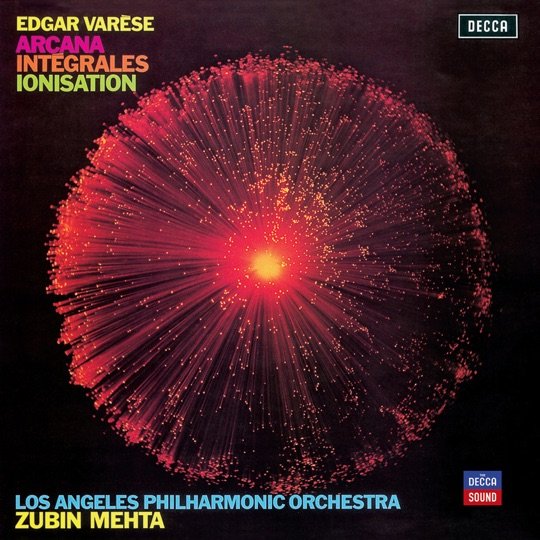
Today I have pulled out a 1995 CD issued by Decca in its “The Classic Sound” series of the day. That was early days in what has become an ever-swelling rush to repackage and re-monetize the back catalogs. And this particular album is a good example of just how muddled things can get.
The performance on this CD that matters is the early-career Zubin Mehta, leading a thrilling set of masterpieces by Edgard Varèse, with the Los Angeles Philharmonic. We have Arcana (1925–1927) and Intégrales (1923–1925) for the full orchestra, and Ionisation (1929–1931) with the spotlight on William Kraft’s Los Angeles Percussion Ensemble.
My first copy of this recording was the original LP, released by Decca/London in 1972 (recording took place in 1971). I played it to death. Decca didn’t get around to putting it on CD until 1995, fully 15 years into the digital era. And unfortunately, they made a poor choice by coupling the Varèse with a very dismal earlier 1968 tape session, consisting of compositions by William Kraft. This is really not music anyone wanted to hear, not in 1968, not in 1995, and certainly not today! I get the logic of nodding to Kraft’s involvement in the Varèse session, but… what were they thinking?
Anyway, I was happy to have the CD, I just listened to the Varèse, happy to be free of clicks, pops and wows, and ignored the added music. I’m pretty sure I never listened to the Kraft portion again, after that first time.
So now that I’ve pulled it off the shelf for a re-evaluation, what is it competing with online? I’m happy to see that the full Varèse session is available on all the streaming services. A quick spot check, and it’s clear that the online version is identical to the 1995 CD, no obvious remastering, so it sounds just like you expect. All good.
But here’s the strange thing: William Kraft is gone! It looks like the same album (cover art and all), but in place of Kraft’s unfortunate efforts we have a new coupling: Mehta and the L.A Philharmonic’s later 1979 recording of Charles Ives’ Symphony No. 2. So this isn’t the same album after all.
I’m not complaining. This is a very fine take on the Ives, and well worth a listen in any context. So cheers to Decca on coming to their senses. But the Varèse! These performances sounded in 1972 like a kind of vindication. It was all the evidence we needed that this music, met at its premieres with ridicule and walkouts, would sound brilliant in the right hands. Mehta’s Arcana is all muscle and swagger, the huge orchestra pivoting on a dime; Intégrales has a lean, snapping precision from the Philharmonic’s winds; Ionisation, recorded with such care and presence, finally makes stirring audible sense compelling music rather than a novelty (I’ll have to come back to this another time to discuss the historic first recording supervised by Varèse himelf).
Decca’s proudly-heralded “ffss” recording technology of the time really does makes its point. Everything here was recorded at Royce Hall, UCLA, using Decca’s custom-built “MASPERE/GENDEC” mixing desk (read the lovely program booklet for all the nerd-friendly technical details!) and an equipment locker full of microphones and tape decks that will make a modern recordist drool. And the results remain reference-grade analogue engineering: a deep, wide soundstage with the complex instrumental forces placed in a real, believable space. It sounds just a little harsh to modern ears, maybe, but fully enjoyable nonetheless.
All things considered, I’ll be happy to retire my well-used old CD. But there’s still another twist to the tale. No, it’s not an Atmos remix… better than that, perhaps. Decca has gone purist after all, cast off the odd couplings of repertoire that took a bit of shine off the brilliant Varèse set, and thrown right back to 1972.
This past May, they released an opulent (and expensive!) remaster of the original LP in their “Pure Analogue” series of limited edition vinyl collectors editions. They tell us they’ve cut it fresh from the original quarter-inch stereo tapes at Emil Berliner Studios and so forth. I can’t tell you if its worth the “upgrade”, it’s a luxury buy I’m still circling warily. But it’s definitely a great way to recapture the magic vintage aura.
And who knows? They’ve gone to this much trouble to turn back time to a great recording. Why not give us the deluxe digital treatment next?
Favorite Moment
Ionisation, around the 3:55 mark. Varèse withholds his pitched instruments for the entire piece, then lets chimes, followed by piano and glockenspiel, enter only on the final page, it’s like colour flooding into a black-and-white film. The L.A. players place those chords with such sang froid that makes an effect all out of proportion to the gesture.
Further Listening
Pierre Boulez, Amériques • Arcana • Déserts • Ionisation (Deutsche Grammophon, 2001). Chicago power under X-ray lighting. Boulez clarifies where Mehta ignites; every strand is audible, though some of the physical danger drains away in the process. It works, after its own fashion.
Riccardo Chailly, Varèse: The Complete Works (Decca, 1998). The Concertgebouw’s plush warmth is a world away from Mehta’s Californian glare – Varèse as late-Romantic inheritor rather than demolition man. The completeness makes it the essential library set; the temperament makes it the gentler companion.
William Kraft: Concerto for 4 Percussion Soloists, Contextures I (Cambria, 1993). If you are the one person who wants to hear these 1968 performances, which are no longer included in the online version of the Mehta/L.A. Philharmonic Varèse package, here is a re-issue devoted to William Kraft, including the two recordings in question, plus some other un-inspiring compositions from an un-identified session dated 1970. For the record.
And a book…
Felix Meyer and Heidy Zimmermann, eds., Edgard Varèse: Composer, Sound Sculptor, Visionary (Boydell Press, 2006). Strangely, there is no good biography of Varèse available, never has been. This is rather wonderful though: a large, lavishly illustrated 500-page exhibition volume containing 32 essays, manuscripts, letters, photographs and discussions of Varèse’s ideas, and works. It is authoritative and visually impressive, but you might have trouble finding a copy. It is available for online reading in full at The Internet Archive.