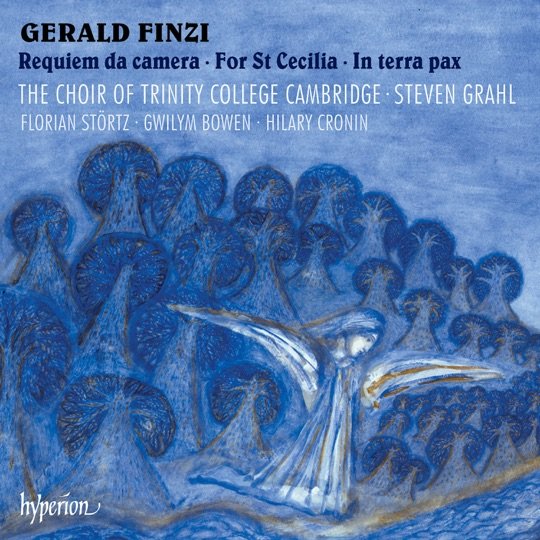

Here’s a treat I didn’t expect on a lazy Sunday morning. A new release from Hyperion just dropped into my “New Releases” feed in Apple Music, looked interesting, so I clicked. And it’s a gentle, warm-hearted delight… just what I needed on the day.
Gerald Finzi is one of those names many of us recognize without having actually heard much of the music. This beautifully devised and executed program featuring the Choir of Trinity College Cambridge makes the case that we’ve been missing out. Unlike so many dives into the back-channels of lesser-known repertoire, the music here is immediately appealing. It surely deserves recognition somewhere closer to the standard repertoire.
The program gathers three substantial Finzi works, each tied to an occasion and each composed for vocal soloists, choir and orchestra. But they are presented here in arrangements with organ in place of orchestra, and these are first recordings of the organ versions (by Robert Gower and Francis Jackson). I’m not familiar with the original versions, but I have to think that little if anything has been lost with the substitution. If anything, the music gains by associating more clearly with the tradition of approachable English church music in the tradition of Stanford, Parry, Howells et al.
“For St Cecilia” (1947) is a ceremonial ode for the patron saint of music, setting Edmund Blunden. “In terra pax” (Peace on Earth) is a Christmas scene in two movements, weaving Robert Bridges’ poetry around St Luke’s account of the shepherds; and Finzi’s early Requiem da camera is a secular memorial to the composer’s teacher Ernest Farrar, lost in World War I, with its unfinished third movement completed here in Christian Alexander’s 2013 edition.
In keeping with the cathedral repertoire Finzi is calling to mind, the music is tonal, euphonious, affirming, and careful in its word painting. But Finzi’s voice grew from an unsettled life: family loss, the shadow cast by both world wars, committed pacifism, and the persistent feeling of being an outsider looking in on English culture. This situates him in the company of 20th-century British composers who never quite fit in: Frank Bridge, E.J. Moeran, Peter Warlock. The subtle edge of the music grows out of that tension between established tradition and the composer’s anxious seeking.
I wasn’t really thinking of all that on first listen, though. What I responded to is the consistently warm-hearted spirit and imaginatively tuneful working-through of the poetry in these pieces, and indeed in the performances. The album, start to finish, has a strong contemplative and “calming” aspect, but within that there is a lot of variety to keep you listening closely.
It helps that all of the singing, both solo and choral, is articulated cleanly so you can follow the lyrics without much need of the supplied texts. The three young soloists are uniformly capable and expressive, and I particularly enjoy how they each seem to present themselves vocally as if they are the choir’s own “star” singers, stepping out into the spotlight, rather than imported divas imposing themselves. Tenor Gwilym Bowen actually studied at Trinity College, so the homecoming is real in his case. Bass-baritone Florian Störtz has recorded Duruflé’s Requiem with this same choir, and soprano Hilary Cronin floats her lines with an unforced purity that suits Finzi’s idiom perfectly.
This is the Trinity Choir’s 30th album for Hyperion, and its debut release under the leadership of Steven Grahl, their recently-appointed Director of Music. And they are in remarkably fine form. Precision, blend, tonal variety, supple shaping of phrases, all in abundance. Listen to how the choir handles the roll-call of past composers in For St Cecilia, where the music turns suddenly inward and reverential. The organ supports the choir without imposing distractions, never posing as an orchestral reduction: straight-ahead cathedral-style organ, supportive, unobtrusive, but always interesting if you choose to pay attention to it.
The recording was made in 2025 at Temple Church, London, and it’s a beauty. The large church has a pleasing natural acoustic that ideally suits the music. The recording team has captured the room with realistic depth, the choir set back at a believable distance, the organ emerging around rather than behind them. The Atmos mix is straightforward and enhances the realism rather than making a show of itself.
I have one small gripe with Hyperion’s program booklet: the organ itself gets no attribution or description whatsoever. This is a fine-sounding instrument in a storied venue, and it surely deserves a paragraph if not a specification? Apart from that misstep, they provide full texts, extensive first-class notes by Francis Pott, complete recording details and so forth… available on services that offer booklets, as well as with disc purchases.
You could call this the sleeper long-listen of the summer – engaging, soothing, heart-warming, never challenging yet somehow engrossing across its full span. And here’s the surprise: the Requiem da camera, the one work here with considerable past form in the annals of recording, isn’t the main attraction. That honor goes to In terra pax, which speaks to how well this album has been curated and executed.
Favorite MomentBack to Top
The angel of the Lord (soprano Hilary Cronin) making her appearance in In terra pax. After Störtz’s baritone has walked us through the frosty Christmas Eve, Cronin’s soprano enters over the hushed choir, interrupting a stillness that stops the room. This is the kind of imaginative narrative flourish that raises Finzi’s voice up, and reminds me to make sure I add this lovely performance to my Christmas music playlist in December.
Further ListeningBack to Top
Choir of Trinity College Cambridge, Finzi: Choral Works (Hyperion, 2019). The choir’s earlier all-Finzi album, under previous director Stephen Layton, including the anthem “God is gone up”. A more liturgical, motet-scaled portrait of the composer, the festive public face to this album’s inward glow.
David Hill, Finzi: Intimations of Immortality & For St Cecilia (Naxos, 2006). “For St Cecilia” in its original orchestral colors, with James Gilchrist and his Bournemouth forces in fine full fettle. It makes for an interesting comparison with the organ version here, revealing how Finzi’s orchestral conception not only survives translation, but gains intimacy.
Richard Hickox, Finzi: In terra pax (Decca, 1979). The classic orchestral account with the City of London Sinfonia, Norma Burrowes and John Shirley-Quirk. Warmer and more cinematic in temperament than Trinity’s candlelit chapel scene; both are worth having.
And a Book…Back to Top
Stephen Banfield, Gerald Finzi: An English Composer (Faber, 1997). The critical biography behind much of this album’s excellent booklet essay. If Pott’s notes send you down the Finzi rabbit hole, this is where it leads. Banfield had access to a mountain of Finzi’s letters, and the composer who emerges is knottier and more interesting than the conventional pastoral-gentleman caricature.