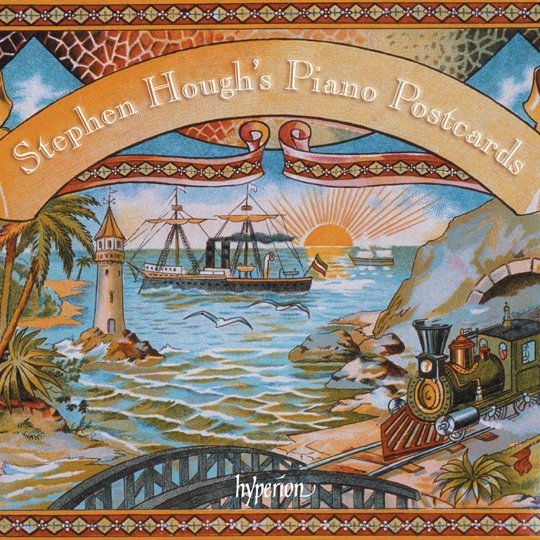

We’ve been waiting quite a while since Hyperion initially put out four pre-release tracks for Stephen Hough‘s new Postcards collection. Based on those selections (especially the excerpts from Hough’s own Mary Poppins Suite), I myself have been quite impatient.
I’m happy to report that it has been well worth the wait.
The full album offers no less than 26 short pieces in all, running about 70 minutes in total. That includes everything from finger-breaking virtuoso turns à la Liszt, to sentimental miniatures and quietly glittering encore pieces.
Hough starts things off with a bang, jumping right in at the deep end with his Mary Poppins Suite. This is Hough emulating Liszt in full: he has composed his own transcriptions (he modestly notes them as “arrangements”) of three songs from the famous 1960s musical, just as Liszt would string together the best bits of the operas of his day for his crowd-pleasing and sensational concerts. This, then, is the opera paraphrase reborn for the streaming age.
I’ll leave it for you to decide how close this comes to the Liszt model. The analogy is a bit shaky if you overthink it, but I’m sure you will notice Hough’s confident way – both as composer and as pianist – with the dazzling technical wizardry and sleights-of-hand that we associate with Romantic era piano razzle-dazzle.
The Suite is a slow burn, building from an ethereal Harry Potter-ish take on “Chim chim cher-ee“, through a stately “Feed the birds” that offers counter-melodies set against filigree passage work that demand a pianist with at least three hands, to the madcap romp of “Supercalifragilisticexpialidocious“, replete with fleeting pastiches of familiar snippets of Beethoven, Weber, Rimsky-Korsakov and Stravinsky to exhilarating effect.
In all, ten of the pieces in Piano Postcards are Hough transcriptions, and every one of them is full of character and compositional panache. As a sidenote, Hough composed several of them (the Mary Poppins set, plus three selections from Disney animation features) on commissions for Lang Lang, another modern virtuoso whose range encompasses both core classical piano repertoire, and popular crowd pleasers. See Lang Lang’s The Disney Book (Deutsche Grammophon, 2022).
On the whole, the album does not come off as an exercise in dazzling showmanship. There are several more flashy showpieces, like Rachmaninov’s transcriptions of Flight of the Bumblebee (Rimsky-Korsakov) and Liebeslied (Fritz Kreisler), or Cecile Chaminade’s Toccata. But the pervasive mood of the whole recital is more like genteel elegance, sentiment and nostalgia.
I find the best way to enjoy the album after first acquaintance is to dip in somewhere at random and listen to five or six tracks, to savor them in small doses. As a rough guide for where to look, you’ll find:
- tracks 1-7 the virtuoso showcase, with Mary Poppins as the focal point
- tracks 8-13 a sentimental interlude featuring Hough’s Disney transcriptions from Frozen, Mulan and Coco
- tracks 14-22 regular piano repertoire encore pieces, centred on Cecile Chaminade (a long-standing Hough favorite)
- and tracks 23-26, a final sigh of sweetness to wind things down (Nature Boy, Woodland Sketches, Waldszenen).
Stephen Hough’s playing, full of charm and intelligence, is the key to tying this all together, making the whole greater than its parts. Every time I listen, I enjoy the relaxed confidence he exudes through every challenge, floating easily over the hairiest technical hurdles, and projecting a kaleidoscope of pianistic colour to meet the atmospheric demands of each piece. He always conveys an easy-going mastery, like someone sharing his delight in these little masterpieces with a few friends, as much for his own pleasure. This allows the simplest pieces in the program (like the Travel Diaries of Malcolm Williamson) to sit comfortably alongside the flamboyant showpieces.
I also want to mention that Hyperion’s production team makes Hough’s Yamaha CFX piano sound like the most perfect instrument imagineable. The recordings took place at St Silas the Martyr church in Kentish Town, in sessions dating to 2020 and 2024. The piano pickup is first-class, projecting a perfectly balanced small-hall perspective with a natural, believable soundstage. And the Atmos mix is graceful in the best sense: it enhances the acoustics around the instrument without ever attracting attention to itself.
I recommend Piano Postcards right up at the top of the current crop of new releases. Do listen.
Favorite MomentBack to Top
Listen to how Hough’s relaxed confidence transforms the Rachmaninov adaptation of Fritz Kreisler’s Liebesleid. Others would play it more assertively, milking the Viennese lilt for every drop. Hough underplays it, keeps it swinging with a conversational rubato. In the end, he lets the piece dissolve in a diminutive fade-out that segues perfectly into an understated, glittering Flight of the Bumblebee. It’s pure magic, and Hough never breaks a sweat.
Further ListeningBack to Top
Lang Lang, The Disney Book, Deluxe Edition (Deutsche Grammophon, 2022). The album for which Hough’s Mary Poppins Suite and other Disney transcriptions were commissioned. Where Hough plays them inward with an inward twist, Lang Lang projects them outward, big and glossy.
Arcadi Volodos, Piano Transcriptions (Sony Classical, 1997). The debut album of an unconventional pianist with a cult following, this is a transcriptions album of a whole other kind, check out the outrageous Turkish March at maximum voltage. Where Hough charms, Volodos dazzles and slightly terrifies. Worlds apart, but equally intriguing!
And a book…Back to Top
Stephen Hough, Enough: Scenes from Childhood (Faber & Faber, 2023). Hough’s coming-of-age memoir, referenced in the album notes, which recalls the boyhood LP collection where his love of these miniatures began. It’s a great read for lovers of pianos and pianists.