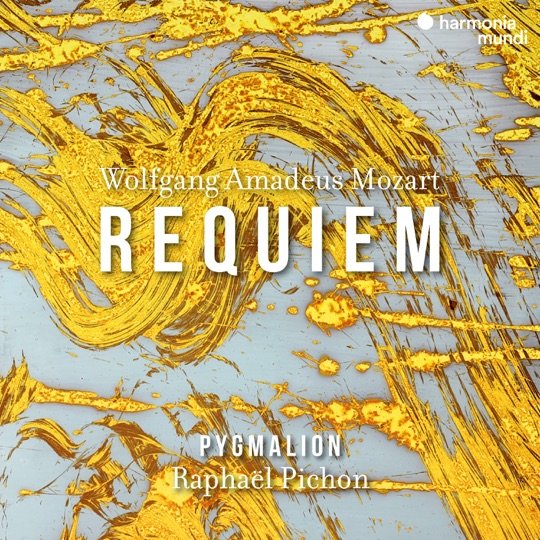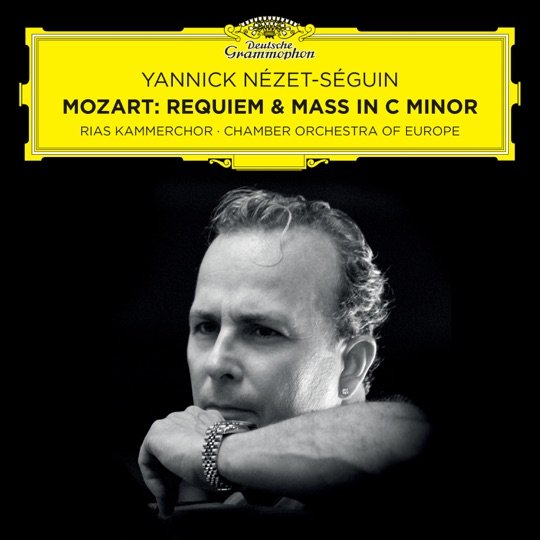

This is the most quietly persuasive Mozart Requiem to come along in a long while. It lacks the enervating energy that drives recent historically-informed recordings such as Raphael Pichon’s brilliant take with Pygmalion last year. But it brings a thoroughly fresh approach, nonetheless, and I think it’s equally likely to warm the hearts of all who love this music.
It’s no surprise that Yannick Nézet-Séguin leans in his own direction. As the Metropolitan Opera’s music director, and music/artistic director of the Philadelphia Orchestra, he works in a tradition that lines up with the Giulinis, Abbados and Karajans we might think of as the old guard and 20th-century tradition of Mozart Requiems. But he is also a Mozartean of standing, and an “Honorary Member” and frequent conductor of the Chamber Orchestra of Europe we hear in this new album. So this certainly isn’t a big-orchestra, high-drama warhorse performance.
What I do find surprising is the emotional pitch of his interpretation, characterized by tenderness, classical simplicity, and gentle pleading, rather than anguished premonition. And at the end he leaves us with a wondering question mark. It’s a compelling combination of calm supplication and faith, joined to a richly operatic stylistic presentation.
Nézet-Séguin has been a card-carrying Mozartian for years, and it shows in how much character he coaxes from his classically-scaled ensemble here. He makes the most of the reduced string count, with decisive, assertive attacks that underpin the choral entries with pointed focus. You will also notice bold wind and brass statements that catch the ear, where a bigger group would smear them.
In proper operatic fashion, the soloists are a main attraction. The quartet is led by up-and-coming soprano Ying Fang, and I also particularly enjoy the firm-toned bass of veteran Michael Volle. All four soloists sing with full expression, and do a lovely job of scaling their opulent technical potential to the emotional restraint demanded by their conductor.
Listen to how the Recordare unfolds, the four voices trading lines with operatic give-and-take, and you’ll hear the philosophy of the performance in miniature. Soon after, the Lacrimosa picks up the same thread – gentle, grieving, hopeful – and hands it to the choir. This is not a Lacrimosa mired in anguish, it’s a Lacrimosa that kneels and weeps quietly. Whether that’s your Requiem is a matter of temperament. I find it moving.
The RIAS Kammerchor is first-class throughout, nimble and clean. I always worry about the sopranos in this music, but here they float the challenging high tessitura work and manage to hit the highest notes without stress.
Now: we must address the complicated issue of the performing edition. Mozart died in the midst of composing his Requiem, so every conductor must decide how, and according to whom, the music will be completed. Nezet-Seguin’s is the first top-drawer recording to use a recent (2019) completion by composer/music theorist Michael Ostrzyga. This is a far-reaching, source-critical rethink that is very different from the traditional Süssmayr completion prepared immediately after Mozart’s death. It includes an all-new Amen that Ostrzyga writes to close the Sequence, and this will absolutely catch your ear. To mine, it sounds plausibly Mozart-ish, but it’s foursquare and clunky. It doesn’t ruin anything, but it doesn’t rise to the occasion either. Later, the reworked Agnus Dei and the Communio drift into genuinely unfamiliar harmonic territory before the “Cum sanctis tuis” pulls you back onto the reassuring Süssmayr rails. If you’re a long-time Requiem obsessive, this might be a reason to seek out this recording: it’s a chance to scrub your ears out – I found it uncomfortable.
The spatial audio, recorded live at the Festspielhaus Baden-Baden at its summer festival in 2025, is detailed, present, with the chorus close enough to read individual lines but never crowding the soloists. Deutsche Grammophon has released this in digital streaming only, which stings a little for a Mozart Requiem I’d happily keep on my shelves in physical form – fingers crossed for a later disc. The Dolby Atmos mix is available on Apple Music/Classical and Amazon Music (and strangely NOT on DG’s own Stage+), and it’s tastefully done: the choir spreads across the back nicely, the soloists stay planted up front but not overly highlighted, and nothing swoons off into the ceiling for effect.
The disc pairs the Requiem with the “Great” Mass in C minor, K. 427. I’d call the Mass a generous encore rather than a compelling reason to seek out this recording. Although… it does feature some wonderful singing, notably again from Ying Fang. Here too, the work arrives in a newish reconstruction, this time by Ulrich Leisinger. So like the Requiem, this is a tradition-adjacent performance bolted onto a distinctly of-the-moment scholarly revision. An odd, interesting pairing of instincts.
Overall recommendation: put this on your list for an immediate listen. At least once, maybe for a lifetime.
Favorite MomentBack to Top
The end of the Requiem, the final track Lux aeterna, from around the 3:08 mark. We are long past Ostrzyga’s 2019 revisions, and firmly back in familiar Süssmayr completion territory, returning to the opening fugue of the Kyrie. But we are also firmly back with Nézet-Séguin’s thorough-going tender optimism, and he brings it home with a startling final cadence that leaves a questioning hush. It’s a brilliant finish.
Further ListeningBack to Top
Raphaël Pichon, Pygmalion, Mozart: Requiem (Harmonia Mundi, 2025). The period-instrument counterweight to everything Nézet-Séguin is doing – sharper, cooler, more theatrically staged in its liturgical framing. A fascinating study in how two very different temperaments approach the same unfinished score. Pichon remains a favorite version for me.
John Butt, Dunedin Consort, Mozart: Requiem (Linn, 2014). Small-scale, scholarly, and radically immediate, using a reconstruction that dramatizes the whole problem of the piece’s completion. Where Nézet-Séguin soothes, Butt confronts – this is the version that thrusts you into the middle of Mozart’s unfinished dilemma.
Carlo Maria Giulini, Philharmonia Orchestra, Mozart: Requiem (EMI, 1979). The grand old plush account that we could say Nézet-Séguin is spiritually descended from, broad and consoling and unhurried. It’s a period piece of a different sort now, but if you want to hear where this warmth comes from, this is a place to start.