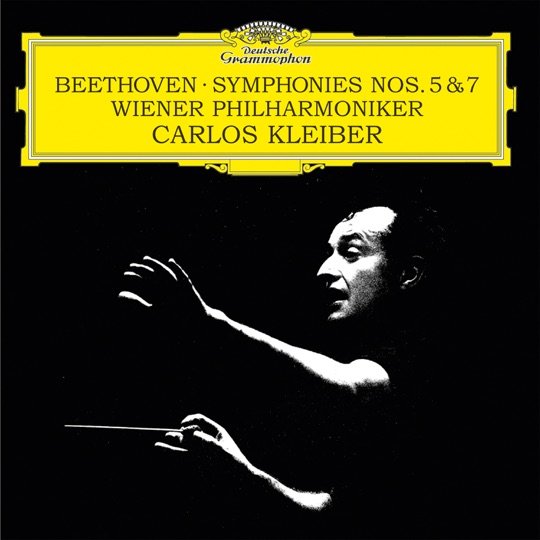

These are performances so iconic and bracing that if you hear them once, you never forget them. And Deutsche Grammophon knows it. Which is why the label keeps hauling the original session tapes back into the workshop for a make-over. DG remastered them for the high-res digital era in 1995, and now they’ve done it again for the spatial audio era, with a Dolby Atmos mix that arrived as a companion to the 2024 refresh in the Kleiber Complete Recordings box set.
So the question this time isn’t whether the performances are great. The question is: has anything been lost in translation? Or does Atmos bring extra sizzle and impact to a recording we already know inside out? Oh… that’s three questions. Oops.
Some context for those of you who are young enough to have missed the story the first time around. Carlos Kleiber, son of Erich, and even more allergic to the recording studio than his famously exacting father, left us only a handful of studio albums. And this is the one that made his legend. The Fifth was taped in the Musikverein in the spring of 1974, the Seventh across sessions in late 1975 and early 1976, with a Vienna Philharmonic that had this repertoire in its bloodstream.
My copies of the original LP pressing, and then the DG Originals series digital remaster CD, have sat within arm’s reach of the player in my music room for decades. I can’t even guess how many times I’ve listened to them, but the music still comes ripping straight through the speakers to my heart, whether it’s two.. or six… or now eight speakers.
Why? Because Kleiber does the seemingly impossible, juggling multiple competing facets of the music without ever losing sight of the underlying narrative of tension and release. He shapes the orchestra’s phrasing in detail – a little swell in the violas here, an unexpected articulation in the woodwinds there; and at the same time, he carries a long architectural line on several time scales, within sections, movements and then the whole of the work, with unflagging intensity from start to finish.
You can listen to this remarkably controlled performance in many different ways. I often pay attention to Beethoven at the crossroads of musical eras, his body planted in the tidy gestures and structures of the Classical, his soul stretching toward the emotional expanses of the Romantic. Kleiber never indulges in excess, yet evokes foreshadowings of Wagner.
I say controlled, but Kleiber’s approach is also forcefully driven. His tempi are classically constrained – no big extremes or untoward accelerations. And yet he keeps us on the edge of our seats, feeling a sustained momentum from start to finish, by small inflections of rubato, and a feeling he is always a microsecond ahead of the beat. And the playing! Kleiber could not do any of this without a superbly disciplined orchestra, and this is the Vienna Philharmonic at its peak form.
But what about the sound: how does this great performance land in DG’s spatial audio remix?
The original stereo, captured to analog tape in the Vienna Musikverein’s Grosser Saal by DG’s 1970s team, presents a bright, forward balance – vivid, with a realistic stereo spread, and maybe a bit of high-end edginess that suited the performance. The 1995 digital remaster smoothed the picture and deepened the soundstage by a few degrees, without doing any harm.
The new Atmos mix, prepared from the original session tapes, rather dramatically evokes a believable concert hall acoustic. The height channels carry the room’s air, perhaps a bit too much and too reverberant for some listeners. The big gain, to my ears, is a remarkable improvement in the depth of the sound stage, and focusing of the stereo spread. So we hear a realistic positioning of the instruments front to back, and an absolutely uncanny tracking of the sections from left to right. There is also a notable expansion of the overall dynamic range compared to previous masterings, which brings still more realism. I would love to know exactly how the engineers at Emil Berliner Studios accomplished all this, it is no small achievement.
My tip for maximum enjoyment of the new mix: crank up the volume! I don’t have an opulent Dolby Atmos set up, just a really good 5.1 surround system with front elevation speakers added. But with audio at realistic concert hall levels, the slightly too-wet presentation of this remix falls away, and the result is one of the best evocations of a real concert hall experience I’ve ever heard. I hope you can get that too.
So where does that leave us? Can you live without this new version? Sure… it’s the performance that is the miracle, and it works in every format DG throws at it. But if you have the gear, the Atmos remaster is the most physically involving way to hear it today.
Favorite MomentBack to Top
It’s hard to narrow this down, with a recording that is surprising and joy-inducing from end to end. I’ll suggest the third movement of Symphony No. 5, beginning at the 3:30 mark, the start of the extended coda that builds into the radiant final movement. The bassoon changes the mood with an inquiring phrase, then the woodwinds pick up the tentative thread with a lightly detached articulation, the upper strings joining in a hair’s breadth behind the beat, evolving to a lighter and sharper pizzicato. This is mostly just what Beethoven wrote, but Kleiber finds a way to hold the cautious yet hopeful march in check, while still inflecting it with constant emotional subtleties that are simply gripping. Keep listening for the radiant transition that inevitably follows.
Further ListeningBack to Top
Erich Kleiber, Concertgebouw Orchestra: Beethoven Symphony No. 5 (Decca, 1953). The father’s Fifth is a fascinating study in shared DNA expressing itself in opposite temperaments. Erich Kleiber is patrician, architecturally lucid, every climax prepared rather than pounced upon.
Herbert von Karajan, Beethoven: 9 Symphonies (Deutsche Grammophon, 1977; Atmos remaster 2023). Another flagship of DG’s Atmos catalogue, and a useful control experiment: Karajan’s molten legato responds differently to spatial treatment than Kleiber’s sinew. The 1970s Seventh is superb in its own upholstered way.
Manfred Honeck, Pittsburgh Symphony Orchestra: Beethoven Symphonies Nos. 5 & 7 (Reference Recordings, 2015). A modern audiophile benchmark for this exact coupling, recorded natively in high resolution. Honeck is leaner and more detail-obsessed than Kleiber, and it shows what these symphonies sound like when the engineering never needed improving in the first place.