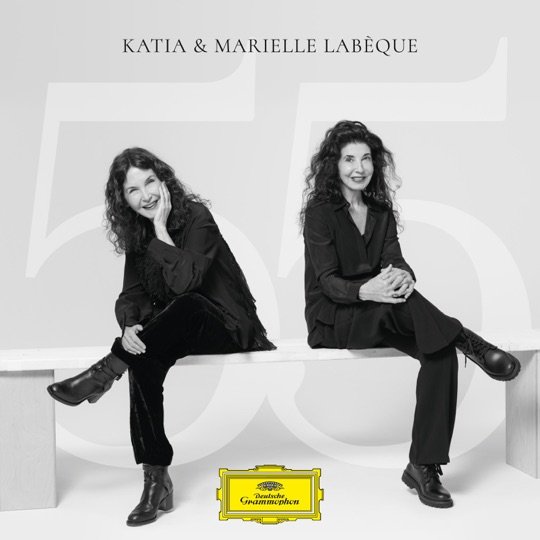

My own memory of duo pianists Katia and Marielle Labeque extends right back to their first recording, the ground-breaking album of Messiaen’s Visions de l’Amen that came out on Erato LP in 1970. I caught up with that inspiring disc a couple of years later, when the once ever-so-useful Musical Heritage Society (MHS) label re-issued it for the North American market under their licensing deal. That was my first contact with both Messiaen and the Labeques, and I’ve been following both composer and performers with keen interest ever since.
So you can imagine how pleased I am to have this new Labeque “55” anniversary collection to enjoy… however odd the idea of a 55th anniversary may be (as opposed to – say – 50th or 60th?).
Their origin story is worth retelling. In 1969 two teenage sisters, fresh from winning first prizes at the Paris Conservatoire in the same year, were in a practise room at the Conservatoire, working on Olivier Messiaen’s then-new Visions de l’Amen for two pianos. The composer himself walked by, heard them rehearsing, walked right in and asked them on the spot make a recording… under his direction! He could no longer play it himself, he said. That recording, released in 1970, launched their careers. Messiaen introduced them to Berio, Berio led to Boulez, Boulez to Ligeti, and so on — each composer recommending them on to the next. So it’s fitting that this set closes with the blazing “Amen de la consommation” from that debut album.
But the intriguing story of “55” today is what the sisters have chosen to present, in the here and now. They have built a collection of 55 short selections, with great care to provide insights into the arc of their careers together. There are 30 archival tracks, re-releases of material dating back to that first Messiaen album; alongside 25 new recordings made for this set in 2025. The selections are organized into three conceptual groupings (3 individual CDs if you choose that option) tracing the key elements that explain their musical preoccupations over the years.
Part one, Wild Is the Wind, is a tribute to “wild” women – artists like Nina Simone, whose 1960’s performance of that song is the source of an elaborately blue transcription that opens the album. The theme carries on with Margaret Bonds, the first Black soloist to appear with the Chicago Symphony; and the trending favorite of recent years, Grażyna Bacewicz, who had the courage to make music despite being told it wasn’t hers to make. The concept of wild outsiders spills over into a group of jazz and stride-piano boundary breakers.
Part two, Of a Bright Garden, is a reminiscence of childhood – their own, and others’. We hear Fauré’s “Dolly” Suite, which provoked the young sisters into turf wars over the keyboard (“You’re in my way!”), Ravel’s “Le jardin féérique” (The Fairy Garden) from the Mother Goose suite, Lili Boulanger’s two garden pieces, and Fanny Mendelssohn juxtaposed pointedly beside brother Felix. The Labèques were born a few kilometres from Ravel’s house in the Basque country; and their mother had studied with Marguerite Long, carrying a direct French performing tradition into the family home. This is repertoire that lives close to home for them.
Part three, Points of Light, gathers up the newest generation of composers, a constant the sisters have maintained through their recordings and concerts over the decades: Berio, Pärt, Glass, Dessner, Cage, Stravinsky and finally Messiaen. Berio’s Memory, which they first encountered decades ago, but never recorded before, is this chapter’s focal point. And they deliver a stellar performance, conjuring shimmering layers that overlap, rise and recede, never losing a sense of compelling momentum and long line. It is also arguably the most “modernist” selection of the whole album, bringing to mind that the Labèque’s fix on new repertoire has mellowed considerably over the years. Much of the rest here is lighter minimalist fare, plus some Satie and Stravinsky.
There’s no need to dwell for long on the quality of performances in “55”. Katia and Mirielle Labèque have been a leading piano duo of their time, with few missteps along the way. Everything here is played with refined sensibility, high spirits when called for – as it is in James P. Johnson’s Carolina Shout – and precision virtuosity too, a la Russian Dance from Stravinsky’s Petrouchka. Just pick the music that suits your fancy, and you’re in good hands with the Labèque sisters.
The physical box of CDs is a handsome object: Brigitte Lacombe’s photographs spanning four decades, a substantial booklet with an essay by Renaud Machard. And the discs sound reasonably consistent across the varied provenance and sources.
The streaming offering is harder to recommend, especially on DG’s own Stage+ service. The issue is that the earlier recordings (anything pre 2020) are offered in the original stereo, without any apparent attempt to remaster and normalize levels and balances: while everything newer appears in very good-sounding Dolby Atmos. But the Atmos selections are mastered at such a low loudness level that it’s impossible to set your system’s controls to a manageable mean. If you set it for comfortable Atmos listening, the next stereo track will blow you out of your easy chair… maybe break your lease, as they say.
Here’s the technical jargon if you’re interested: the Atmos standard demands far more headroom than regular hi-rez audio. This gives Atmos recordings greater capacity for sonic realism, and avoids the compressed, flat soundfield characteristic of modern stereo practice. Atmos is regulated to a reference level of -18 dB LUFS (average loudness), while typical stereo streams run heavily compressed and much hotter, by about 10 dB or so. On Stage+ they have the differential much too wide, and it’s especially bad for this album. I have no idea why: the implementation is simply broken. This is one reason why I don’t particularly recommend Stage+, in spite of its home-team advantage for the Universal catalog, and its useful selection of video productions. Apple Music and Apple Classical handle the master level matching a lot better, although you still have to ride your volume control at times. At any rate, a collection like “55”, where the tracks are assembled from varying ages and qualities of source material, and the engineering folks haven’t paid attention: beware!
Bottom line: this collection is well worth your time, especially if you have followed Katia & Marielle Labeque over the years. You can dip in pretty much anywhere, and enjoy the sisters’ vivid and deeply felt music making. Just stick with the CD box, or a better streaming service.
Favorite MomentBack to Top
With so much choice, it’s hard to settle on a single highlight. But I’ll go with the Labèque’s new take on Ravel’s “Le jardin féerique” from Ma mère l’oye. The performance is marked by tender sentinment, without excess. Ravel builds to a final regal climax, and the sisters refuse to rush it: listen at the 2:45 mark, where the bell-like sonorities open above the melody, and the four-hand texture suddenly sounds as big as an orchestra. The track is marred somewhat by DG’s indulgence in the suffocatingly close perspective that is an unpleasant fad of the moment for the “piano content maker” crowd (the mics are so close you can hear one of the sisters humming quietly to herself!). But I guess we can cope with that, for such lovely playing.
Further ListeningBack to Top
Katia & Marielle Labèque, Dessner: El Chan (Deutsche Grammophon, 2019). The source of the two Dessner excerpts on disc three, heard here complete with his Concerto for Two Pianos – cascading notes, thrilling rhythmic interplay, and thrusting energy. In this context, focused on one composer, one sustained sound-world, the sisters are as persuasive going deep as going wide.
Steven Osborne & Martin Roscoe, Messiaen: Visions de l’Amen (Hyperion, 2004). Where the teenage Labèques recorded the work under Messiaen’s own direction, Osborne and Roscoe trust the printed score – including tempos the composer himself ignored. The result is graver, more relentless, a fascinating study in how far a composer’s supervision and a composer’s notation can diverge.
And a book…Back to Top
Anna Beer, Sounds and Sweet Airs: The Forgotten Women of Classical Music (Oneworld, 2016). Women composers from Caccini to Maconchy, with substantial chapters on both Fanny Mendelssohn and Lili Boulanger.