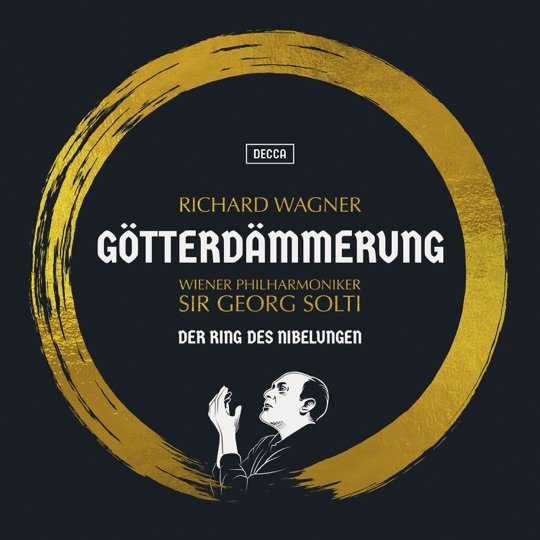

Götterdämmerung is the last opera of the Ring cycle, but I’ve picked it as the first of the series to dig into from Decca’s new remaster of Georg Solti and John Culshaw’s astounding and historic complete set, recorded in the years 1958 – 1964.
This is personal for me. Solti’s Götterdämmerung was the first opera recording I ever bought, around 1970. I was a teenager then, and still taking first steps in my discovery of the classical music world. I literally grew into my career and life’s work under the influence of this recording. In fact, it was life changing.
I bought it on LP, although I remember I could have picked it up on open-reel tape at the time, if you can believe that! I went on to buy the other three operas to make the complete set over the next year or so, one box at a time… along with lots of other good stuff on “vinyl” as we call it now.
Why do I say the Solti Ring was life-changing? It’s great music, of course. But it was the brilliance of the recording, the audacious conjuring of a vivid soundstage, the compelling drama so enhanced by the wild ambition and deep commitment to excellence and innovation of the production team. I didn’t know it at the time, but their achievement set the standard for my expectations of, and enthusiasm for, excellent audio recording as a primary venue of musical experience.
This was the culmination of a seven-year project to produce the first complete studio recording of Wagner’s Ring cycle, and Culshaw’s ambitions for it were almost absurdly grand. He didn’t want to simulate a stage performance; he wanted a studio creation that would surpass what any opera house could deliver. He spoke of this as “theatre of the mind.” The proof is everywhere in this Götterdämmerung: the custom-built “steerhorns” for Act II that Culshaw demanded because trombones are such a poor substitute; the cinematic sweep of the orchestral interludes; the way the Sofiensaal’s acoustic seems to expand beyond its walls when the Vienna Philharmonic is in full cry.
And the performances! Birgit Nilsson’s Brünnhilde is simply the summit of Wagnerian singing in the twentieth century. The voice is enormous, incandescent, and her interpretation is musically astute throughout. Wolfgang Windgassen is ideally cast as the Siegfried: ringing and heroic without bluster. Gottlob Frick’s Hagen is one of the great bass portrayals on record, dark-toned and genuinely sinister. And Dietrich Fischer-Dieskau brings an almost uncomfortable intelligence to the weak-willed Gunther, exactly as Culshaw intended when he cast him in that role. Solti drives all of this with unrelenting energy, and compelling dramatic thrust.
So if you don’t already know these recordings, they are must-listens. And you can take it from me, as an OG enthusiast of the recordings, that they sound better than ever, more impactful and more exciting than ever, in this remastered surround sound marvel. It’s hard to believe that such an aural spectacular originates in stereo recordings of the 1960s. The palpable sense of a real three-dimensional space where dramatic action of cinematic dimensions takes place is markedly elevated in Atmos. Essential listening today.
For now, the Atmos version is digital-only, available on streaming services but not on disc. You can get a limited edition SACD (4 discs) with the new remaster, or vinyl if you prefer, but those versions are stereo only. Fingers crossed for a Blu-ray release with “the works”… but that has not been announced.
Favorite MomentBack to Top
Act III, after Siegfried’s murder, when the full orchestra erupts into the Funeral March. I first heard this on the London (Decca) LP pressing I bought as a teenager and I remember sitting dumbstruck, not understanding that a recording could deliver something of that magnitude into my little apartment living room. The Vienna Philharmonic brass here is terrifying in the best possible way, blazing without losing pitch. In the Atmos remaster, the sense of the hall opening up around the orchestra is even more overwhelming than in stereo.
Further ListeningBack to Top
Herbert von Karajan / Berlin Philharmonic (Deutsche Grammophon, 1970)
With Gundula Janowitz, Martti Talvela, Helga Dernesch et. al. Karajan’s Ring is a worthy alternative to Solti: more inward, more concerned with orchestral texture as primary carrier of meaning, less concerned with dramatic projection. Dernesch’s Brünnhilde is warmer-grained than Nilsson’s, the interpretive approach tending toward lyric beauty rather than heroic force.
Christian Thielemann, Vienna State Opera (Deutsche Grammophon, 2013)
A modern alternative, recorded live at the Vienna State Opera, and released as part of Thielemann’s complete Vienna Ring cycle. This is Wagner in traditional garb. The Vienna forces produce a sumptuous, darkly glowing orchestral sound, and the recording quality is among the finest ever achieved in a live-staged Ring. Thielemann shapes the score in a broadly symphonic manner, emphasizing long spans, orchestral colour, and Wagner’s network of leitmotifs.
John Culshaw: The Art of the Producer — The Early Years 1948–55 (Decca, 12-CD box set, 2024) is a centenary celebration of Culshaw’s career before the Ring, featuring the 1951 and 1953 Bayreuth recordings, a recovered Clifford Curzon tape, Copland playing Copland, and much else. The booklet essay by Dominic Fyfe provides context that illuminates the Ring recordings themselves. This set reveals the full arc of the career that made the Götterdämmerung possible.
And a book…Back to Top
And how about some reading? If you are intrigued, as I always have been, by John Culshaw’s revolutionary approach to big orchestral and operatic recording methods, look these up.
John Culshaw, Ring Resounding (Viking Press, 1967; reissued 2003) This is Culshaw’s own account of the entire Ring project: the seven-year struggle with Decca management, the casting odyssey, the technical innovations, the personalities. It remains one of the most candid and absorbing books ever written about the classical recording industry. Culshaw also left a posthumous memoir, Putting the Record Straight (1981), which is considerably less diplomatic and well worth reading alongside it.