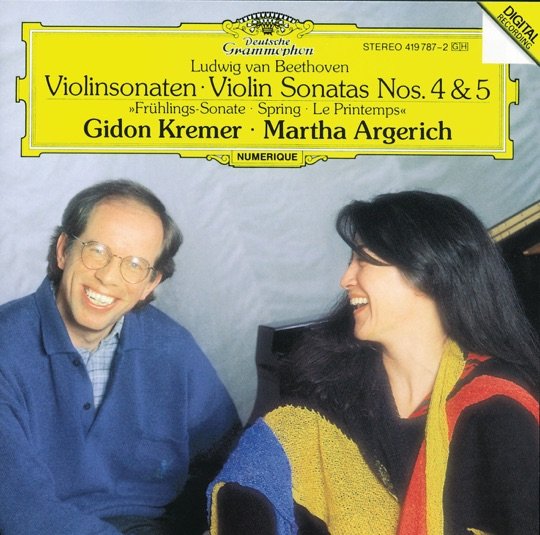

This is the first entry in a new category of reviews I am calling “Off the Shelf”: in which the critic pulls a disc from the shelves of CDs and LPs that are gathering dust in the music room, and gives it a new appraisal.
I’ll admit that to get things rolling, I didn’t leave the choice of album entirely to chance. I still have nearly 2,000 CDs and LPs in the house, and you know they can’t all be winners. But this one is a cherished favorite that I’ve listened to with pleasure many times over the years.
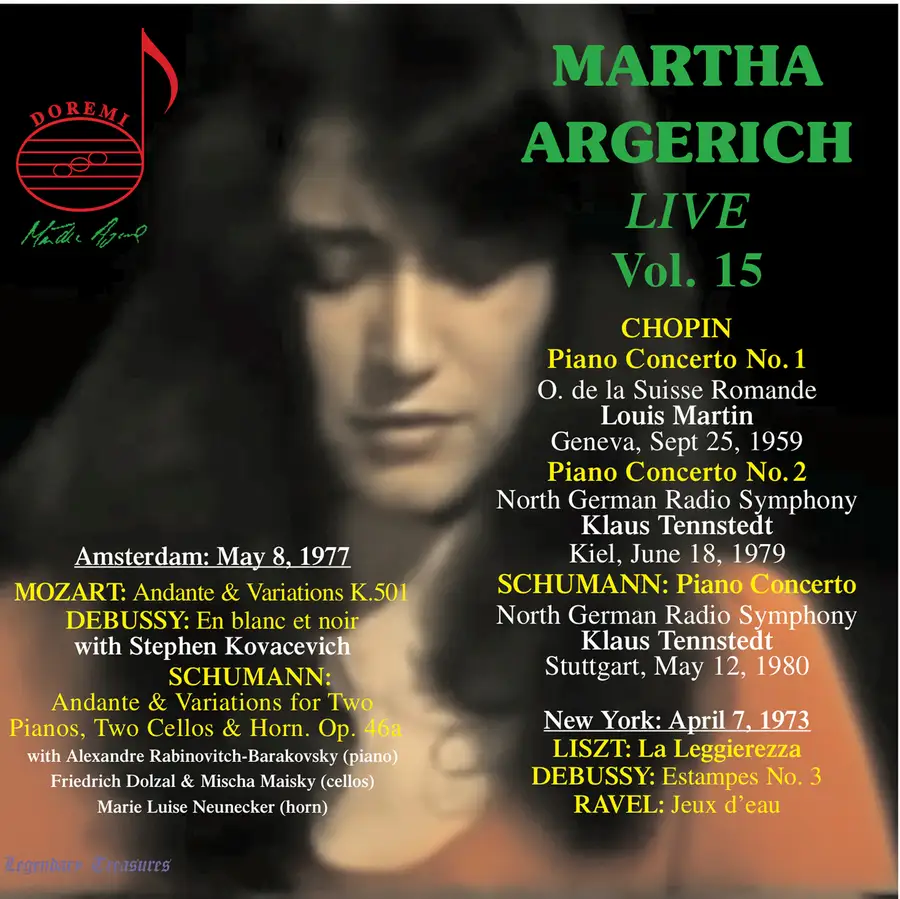
Martha Argerich and Gidon Kremer recorded all of Beethoven’s violin sonatas as a series of four separate albums, taking their time and presenting them in chronological order over a 10-year period from 1984 through 1994. Not like today when major artists are likely to blast through the complete-whatever as if there’s no tomorrow – probably because that’s what their label A&R is pushing them to do.
This is an important period in Argerich’s career, when she was turning away deliberately from the firebrand virtuoso solo piano repertoire she made her early reputation on, and building a new chapter based on collaboration, as a chamber musician and as a concerto soloist. In the chamber music realm, Kremer was a notable partner, along with the likes of Mischa Maisky, Renaud Capucon, Daniel Barenboim, and Nelson Freire.
This album with the Op. 23 and Op. 24 sonatas (Nos. 4 and 5) is the second of the Argerich/Kremer cycle, recorded and released in 1987. This is an attractive pairing, contrasting the restless energy of No. 4 with the sunny disposition of No. 5 “Spring”. I remember that when this album came out, it was an immediate hit with listeners and reviewers (nominated for the classical music Grammy award in 1989). A lot of the praise and attention attached to the more dramatic Op. 23. But for me, there is more magic in Argerich and Kremer’s Op. 24.
Listen to how they handle the opening Allegro. Other performers might let the familiar placid melody unfold, simple and lovely. Instead, Argerich’s left hand sets a gentle propulsion in motion from the outset, and keeps shaping that energy as a counterweight to the sweetness of the melodic lines that develop and trade back and forth between piano and violin. Kremer matches Argerich’s alertness and brings an edginess of tone and inflection that takes this performance into unexpectedly deep territory.
This is characteristic of the whole album. They are playing relatively early Beethoven, but approaching it with drama, contrast and expressive range that is more aligned with later, stormier, Beethoven. And they never let it tip over into exaggeration that feels out of place.
I love the riskiness of their teamwork. Kremer’s tone is lean and bright, occasionally wiry, and he plays with astringency and a sense of danger. Argerich’s piano is a catalytic force rather than polite partner, with the colour and imagination of a born virtuoso. She and Kremer trade phrases like two people finishing each other’s sentences, and there’s a wonderful sense of risk in it, the feeling that either might push the tempo or lean on a sforzando and dare the other to follow. They’re throwing off sparks.
Favorite MomentBack to Top
The slow movement of the “Spring” sonata. The opening phrases catch me off guard every time, it’s a breath-taking start to six minutes of utterly compelling musical dialog. Argerich leads off with the melody, Kremer responds with deepening emotional richness, and they continue trading off back and forth like that for six minutes you’ll never forget. There’s a point midway where the violin seems to hang suspended, waiting, and Argerich answers underneath with a touch so soft it barely disturbs the air.
Further ListeningBack to Top
Isabelle Faust, Alexander Melnikov: Complete Beethoven Violin Sonatas (Harmonia Mundi, 2009). The modern benchmark for the whole cycle. Faust’s period-informed leanness actually sits close to Kremer’s aesthetic, but her reading is cooler, more analytical, less willing to take a risk on the wing. A fascinating study in how two very different eras chase the same clarity.
Renaud Capuçon, Frank Braley: Complete Beethoven Violin Sonatas (Erato/Virgin, 2010). Worth hearing partly because Capuçon later became one of Argerich’s own regular chamber partners. Smooth, elegant, beautifully balanced playing that makes an instructive contrast with the sharper edges Kremer brings to this same repertoire.