
There’s not much to say about Schubert: Treasures, and I mean that mostly as a compliment. Truth is, this is trivial repertoire: simple dances of a minute or so each, mostly in three time with basic oompah left-hand accompaniments, written for the parquet floors of Biedermeier Vienna rather than the concert hall.
Rudolf Buchbinder, a distinguished elder of the piano world, recorded the whole lot in a single day in July 2024. He plays with unflagging good humor and attention to detail, giving the simple music more than its due. The question is: why?
The programme gathers all eight of the dance collections Schubert published in his lifetime: the 36 Originaltänze (Original Dances), D. 365 (with the once-famous Trauerwalzer as its second number); the 34 Valses sentimentales, D. 779; the 12 Valses nobles, D. 969; the late 12 Grazer Walzer, D. 924; plus the German dances, Ländler and écossaises of D. 145, D. 734, D. 735 and D. 783. That’s 160 tracks and just over two hours of music. For context, this is the third entry in Buchbinder’s series of short-pieces albums for Deutsche Grammophon, after Soirée de Vienne (2022) and Brahms-Reger Song Transcriptions (2024) — all three available in Atmos spatial audio.
The album arrives at a hinge point in a very long career. Buchbinder, an honorary member of the Vienna Philharmonic, and a DG exclusive artist since his Diabelli Project of 2020, turns 80 this December. He will hand over the artistic directorship of his Grafenegg Festival in October. And he saw a concert hall bearing his own name open on the very day of this release (May 26 2026). Such auspicious timing might warrant an album release a little more… momentous? Instead, he gives us the opposite, choosing the smallest music he knows, these Schubert’s dances he likes to call “miniature worlds with a gigantic heart”. And he offers a disarmingly practical reason why a lifelong Schubertian waited this long to record them: they were always too short to work as encores!
Buchbinder plays it straight, giving full respect to the modest charms of the pieces, playing up the prettier moments – a felicitous melodic turn here, an unexpected slip from major to minor there – without indulgences or exaggerations of any kind. This is Classical playing to the hilt, with no emphatic rubato, no attempt to inflate a little trifle into a chocloate fountain. The pieces get their full due and not an ounce more.
Now, you might be wondering, as I did: are those two titles, the “Valses nobles” and “Valses sentimentales” sets, anything to do with the Ravel? They do: Ravel co-opted the titles for his 1911 “Valses nobles et sentimentales“, with the stated intention of writing a chain of waltzes following Schubert’s example; as well, Liszt mined these same collections for his Soirées de Vienne paraphrases. These are confections that cast a surprisingly long shadow.
But historical resonance is not musical weight. Heard in their own limited context, the Valses nobles are only marginally more ambitious than their neighbours in this collection. And the Grazer Waltzes of 1827 carry a faint late-Schubert tinge… but that’s about it. Listen instead for the small moments that remind us of Schubert’s genius, like the Trauerwalzer’s melancholy tug (a piece once so popular it circulated under Beethoven’s name).
The sound is first-class. Everything was recorded in the Mozart-Saal of the Wiener Konzerthaus, on a single day, on a beautifully regulated piano, with standard DG-quality Atmos spatial treatment: natural placement, tidy room acoustics, and no gimicks. The release exists in physical media as a 2-CD digipack, and the Atmos mix is available on the usual streaming services.
In either format, the programme booklet is worth a moment of your time. The liner notes are by Buchbinder himself, part history lesson, part memoire, arguing that these throwaway dances reveal more of Schubert the man – his social world and his character – than his big works do.
All in all, a worthwhile commemorative package and remembrance. Put Schubert Treasures on shuffle, let it run for an afternoon, and nobody will leave unhappy!
Favorite MomentBack to Top
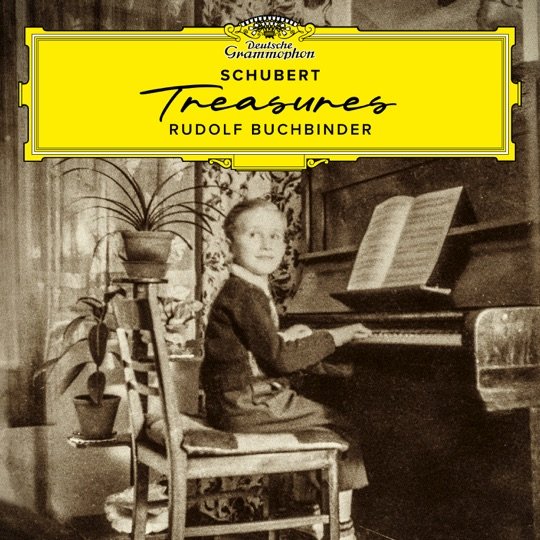
This time, instead of picking a favorite moment myself, let me hand the task over to Buchbinder. The cover photo shows him as a small boy at the keyboard, feet dangling well short of the pedals; the booklet’s final image shows the 79-year-old of today. He describes the album as a deeply personal journey back to pieces that have been close to his heart since childhood. So just pick a track, any track, and let that be the pianist’s moment. It’s a cop-out, I know, but these little pieces are all very charming, and all very interchangeable.
Further ListeningBack to Top
Rudolf Buchbinder, Soirée de Vienne (Deutsche Grammophon, 2022). The previous entry in this series, gathering salon miniatures by Beethoven, Chopin, Schubert, Schumann and Strauss. Where Treasures is a single vast mosaic, this is a curated evening — more variety of colour, less hypnotic accumulation.
Michael Endres, Schubert: Complete Dances (Capriccio, c. 1999). The completist alternative, sweeping in the posthumously published sets Buchbinder omits. Endres is warmer and a touch more indulgent; it works, after its own fashion, but Buchbinder’s classical restraint wears better over two hours.
Bertrand Chamayou, Ravel: Valses nobles et sentimentales (Erato, 2016). Go straight to the Valses nobles et sentimentales to hear what happened when Ravel borrowed Schubert’s titles: the same dance frame, refracted through a century of harmonic sophistication. A fascinating study in how far a waltz can travel.
And a Book…Back to Top
Dances for Solo Piano (Dover Classical Piano Music). Why not have a go at these easy pieces yourself? This is a nice “value” edition, with no less than 350 Schubert dances, including many not published during his lifetime. “Many are less than half a page long, but all of them radiate the melody and charm that have endeared Schubert to the musical world.“