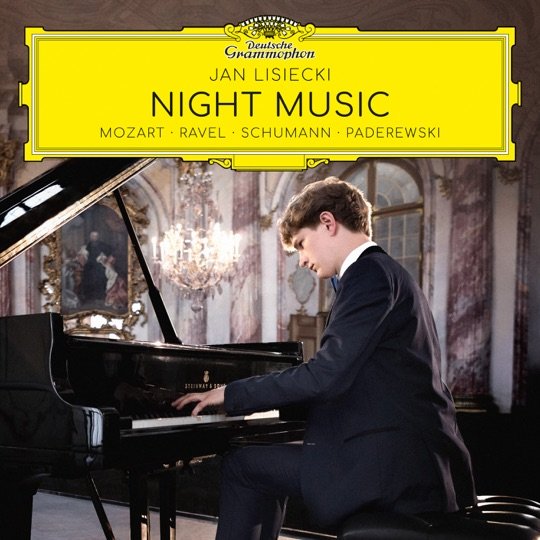

It’s kind of a distraction to entitle this album Night Music. The moniker undermines the real merits of Jan Lisiecki’s performance here.
“Night Music” suggests a vision of repertoire that coheres into a telling evocation of some nocturnal mood. Accordingly, we come here expecting to be told a story, to fall under the spell of a particular emotional affect. Instead we get Mozart’s cheery and trivial variations on “Ah, vous dirai-je, maman” — the tune better known as “Twinkle, Twinkle, Little Star“; followed by Schumann’s neglected Nachtstücke suite, with its euphemistic title masking the composer’s actual preoccupation of the moment with morbid thoughts of death. And then Ravel’s wonderful Gaspard de la nuit. So yes, the word “night” is opportunistically connected to all this repertoire. But it’s a meaningless connection, as only the Paderewski nocturne tacked on as an encore actually evokes any kind of night-like atmosphere.
If you had to pick a marketing-oriented album title, “Stalked by Death” might have been a better choice! Indeed, that might have inspired a more pointed performance.
So. Here in reality is a piano recital built around significant masterworks by Schumann and Ravel. The organizing principle is not atmosphere; it is the keyboard suite as a form, the pianist as connoisseur displaying range. This works well enough: Lisiecki is a pianist with an intriguing talent for joining the elegant formalism of a classisist with the sharp tonal contrasts and ravishing colors of a romantic. But on this go-round at least, he underplays the drama and narrative arc that drives the big pieces by Schumann and Ravel.
Schumann’s Nachtstücke, Op. 23 wants to be heard as a traversal in four movements from funeral procession to consoling roundsong, a tale born of Schumann’s dark sense of being haunted by death in the Vienna winter of 1839. Instead, Lisiecki seems to chunk it out as a collection of miniatures a la Carnaval or Papillon, fleeting vignettes of contrasting moods, but not so much a persuasive through-line.
Gaspard de la nuit fares better. Ravel’s evocation of mood and color is so much more clearly etched, and this plays to Lisiecki’s strengths. This is a fine Gaspard, I’ll listen to it happily any day. But still, I find the dramatic potential within each movement is constrained here, and it makes me wonder if Lisiecki’s programme concept of “night music” puts a damper on his concept of the possibilities. The surface is immaculately managed, the demonic undertow of “Le gibet” and “Scarbo” is held politely at arm’s length.
This is an appealing recital built of moments – many lovely moments! – rather than a compelling tale of some vision of music of the night. The Mozart variations are charming self-contained baubles; the Nachtstücke refrains return without accumulating weight; Gaspard tolls and glitters without menace. The apotheosis you keep waiting for never arrives, and after a while you stop waiting and simply enjoy the surface.
Favorite MomentBack to Top
Among those many moments, an interlude in the third Nachtstück is memorable. Out of the boldly assertive opening declamatory statement, a cavatina rises (from about 0:55 through 2:20): a single vocal line surfacing from the carousal, tender and unhurried, contemplation winning out over the din for one paragraph before the revelry sweeps back in. This is a passage that captivates me every time I hear it: no other performance I have heard comes close.
Further ListeningBack to Top
Jan Lisiecki Night Music in Concert. Stage+ (DG’s streaming service) has video of this program, plus a second half of pieces by Rachmaninov and Chopin. Nicely filmed in June 2018, with an appreciative audience at the Imperial Hall, Würzburg Residence. This is the actual source of the album recordings discussed here, but the video is worth looking up, as the visuals are rich and interesting. The sound quality (with Dolby Atmos where available) is better in the new digital-only audio release, though.
Herbert Schuch: Nachtstücke (Oehms Classics, 2009) is an obvious comparison. This is also a kind of nocturnal concept album around the same Schumann and Ravel works, plus some Scriabin. This might appeal to you if you want a fire-breathing account of these pieces, but it’s not really my cup of tea. Not much nuance . . . or magic.
For first-rate alternatives of the major works. Plenty of choice when it comes to Gaspard de la nuit: I would go first to the iconic recording by Martha Argerich, also on Deutsche Grammophon (1973) [ Apple Music | Qobuz ]. And then for a brilliant take on the authentic French lineage of Ravel performance, listen to Angela Hewitt on Hyperion (2002) [ Apple Music | Qobuz ].
For Nachtstücke, it’s slim pickings, and Jan Lisiecki really sets the standard for complete recordings in modern sound. But try Emil Gilels, a live concert recording from the Great Hall of the Moscow Conservatory on Melodiya (1967) [ Apple Music | Qobuz ]: this is a confident and assertive performance, and quite a contrast to Lisiecki . . . with sound quality better than you might expect from the source.