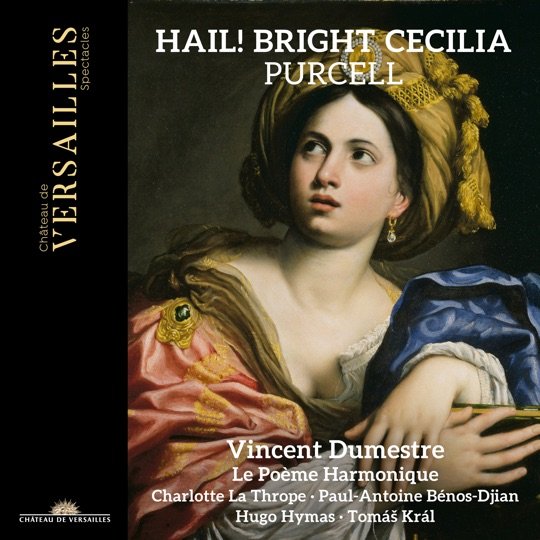

Hail! Bright Cecilia is a much recorded Purcell favorite. And given that it’s indelibly marked as English Baroque, it’s surprising how many of the finest recordings are by performers from other lands! A case in point is this new release in the distinguished Chateau Versailles series.
Perhaps it’s a bit cheeky to suggest that a French ensemble has stepped in on this most English of repertoires, in this most French of venues, and shown up the home team, so to speak. But Vincent Dumestre and his Poème Harmonique choir and orchestra have done exactly that. They capture the heart and soul of Purcell’s ode to the patron saint of music in a performance bursting with character.
Hail! Bright Cecilia is Purcell’s grandest occasional work, a nearly hour-long sequence of choruses, duets and solo airs extolling the virtues of the instruments of the orchestra. The whole point of the work is to characterize each chapter of the celebration with its appropriate emotional character. What the baroques would think of as “affekts”.
Dumestre leans into this architecture. Tempos, textures, and rhythmic energies all combine in an engaging narrative flow that poses each subgroup of musical numbers as a little theatrical event. Both the choir and orchestra are thoroughly attuned to the stylistic norms and mannerisms of the time and place, quite a vibrant performance. This is surely baroque à l’anglaise as it is meant to be.
The lineup of solists is another cause for pleasure. Baritone Tomáš Král sets the tone with a real sense of occasion, and his relish in “Wondrous Machine!” is infectious, while the winds snap back at him in reply. Countertenor Paul-Antoine Bénos-Djian brings elegance to his numbers, and mostly avoids the harshness in upper register that can make the male alto voice a bit of a trial (aided by Purcell, who doesn’t push the singer too hard on this score). And tenor Hugo Hymas also does his role proud, for example handling the cruely high tessitura of “‘Tis Nature’s voice” without strain. Much to enjoy.
The Chapelle Royale of Versailles itself is part of the performance. I’ve been to concerts in this oppulent hall, and I can attest that the recording team have caught the flattering acoustic just right: warm without turning to soup. You hear the bloom around the choir without losing the words. Dumestre exploits the space rather than fighting it. The big homophonic choruses ring out, then the chamber-scaled airs pull you right up close. This serves the “affekt” driven architecture of the music to great effect.
The album notes offer the program as “A Musical Entertainment” for Saint Cecilia’s Day, with an engaging history of how that day was celebrated in Purcell’s time. And so we have a short work by John Blow as an overture to the proceedings. Blow was Purcell’s teacher, the man who handed over Westminster Abbey to his pupil… and then took it back when Purcell died young. His “Welcome Every Guest” is billed as a first recording of its original version, from manuscripts in the British Library. So a bit of a scoop. It’s an ode built over a long ground bass that starts on theorbo and gathers weight as the strings join in. It is a quietly hypnotic thing, and putting it next to the Purcell makes the family resemblance impossible to miss.
Favorite MomentBack to Top
This Purcell is a celebratory work, and the memorable moments are uptempo and indeed bright. But I always find that the big tenor/alto duet leading towards the finale is the heart of the matter. “In vain the Am’rous flute” begins and ends with lovely recorder duet ritornellos (the flute of Purcell’s day); and then the tender, warmly intertwining voices (tenor and counter-tenor here) conjure a magical “affekt” that affirms the enchantment of the listener, overcome by celestial music. The sweetly sinuous lines of the recorders and voices drooping and rising together in the midst of the surrounding pageantry is a Purcell masterstroke. If you were going to just listen to one one movement to represent the strengths of this performance, this would be it.
Further ListeningBack to Top
Paul McCreesh, Ode for St. Cecilia’s Day 1692 (Archiv, 1995). A benchmark for enthusiasm and sheer voltage. McCreesh’s trumpets are bolder and his opening Symphony more irrepressible than Dumestre. Charles Daniels is electric in the high tenor solos. If you want St. Cecilia at full throttle, this is the one, though the sound is not near so nice as Versailles.
Philippe Herreweghe, Purcell: Odes for St Cecilia’s Day (Harmonia Mundi, 1998). Mellower and a touch more elegant than the others, with Mark Padmore among the soloists. A good choice if Dumestre’s brisk sparkle is not quite your taste and you want the music to glow rather than crackle.