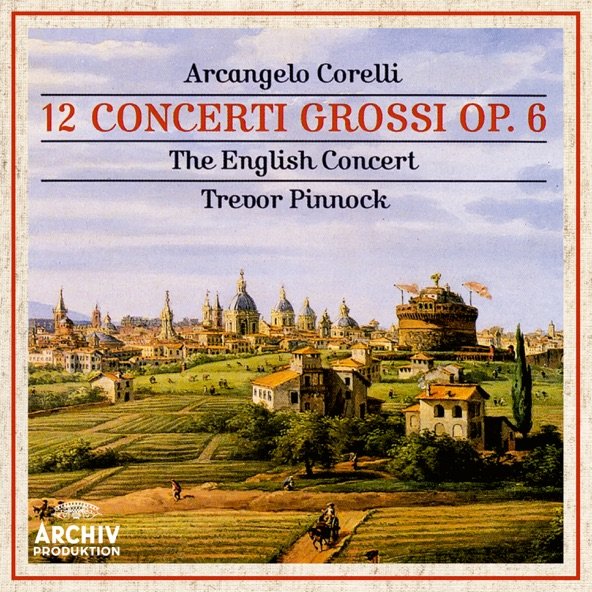

Yes, it’s almost 40 years since this set was originally released. The question here is not whether this is a worthwhile performance, still earning its keep amongst the best Corelli Op. 6 sets today. Rather we might ask: is it worth the effort to re-master such a well-regarded (and in this case, award-winning) recording of an earlier era, to take advantage of modern surround sound?
Pinnock’s Op. 6 was recorded at Henry Wood Hall and Abbey Road in 1987 and 1988, and it was the gold standard of its day, for both historically-aware performance of distinction, and excellent recorded sound.
The Dolby Atmos reissue, available as of now on Apple Music and Deutche Grammophon’s own STAGE+ streaming platform, gives you a compelling reason to revisit this iconic recording of the 1980s baroque revival, even if you’re a long-time enthusiast and you’ve been listening to it all these years.
I can’t tell for certain whether the re-mastering for Atmos is so effective because DG’s engineers have been able to remix from original multitracks (easier), or if they’ve performed wizardry with digital manipulation of stereo masters (dicey). Either way, they’ve done an excellent job. The enveloping soundstage rendered in Atmos is warm and convincing and lovely. My direct comparison with the old CDs says the new mixes are a big improvement on the already impressive sonics of the originals.
I don’t need to belabor the point as far as the performances are concerned. Forty years on, they don’t have quite as much energy and excitement as we have come to expect in the latest generation of authentic practice. But you might actually feel a kind of relief to be spared the extreme tempos and overly-fussy details of phrasing and technique that are often apparent in modern performances. Pinnock and The English Concert play with elegance, vitality, shape and style. And in truth, they were trailblazers of their day in dragging us into a new age of historically-informed performance.
The original Archiv Produktion release won Gramophone magazine’s Early Music Award in 1989, and the intervening decades have not undermined that seal of approval. The discipline of the ensemble is not an end in itself but a means to transparency: you hear every voice, every harmonic inflection, every moment where the concertino trio of Simon Standage, Micaela Comberti, and Paul Goodwin withdraws into the larger texture or steps forward with elegant assurance.
As to the music itself, these concerti are widely admired, much recorded, and yet oddly under-appreciated over the past couple of decades. When was the last time you dug into some Corelli for a good old listening session; as opposed to, say, the latest batch of obscure Vivaldi rediscoveries, or the Bach Brandenburgs? This is inventive and sometimes thrilling music that equals the best of the rest in Baroque repertoire.
The fast movements in this set have rhythmic snap without seeming over-driven, and Pinnock shapes phrases from the harpsichord with an authority that tells you the musicians listening to one another rather than just following a conductor. But I’m actually taken most by the beauty of the slow movements. The largos dotting the more extended concertos — particularly those of Nos. 2, 4, and 8 — are played with a sustained, unhurried beauty that never thickens into sentimentality. Corelli the melodist.
Favorite MomentBack to Top
Check out the opening Largo of Concerto No. 8 in G minor, the famous Christmas Concerto. This is a passage I have tested against a dozen recordings over the years. Can you make something feel both inevitable and surprising? Here, Standage and Comberti in the concertino enter over a hushed ripieno with a phrase so perfectly poised that the rest of the movement feels like a long, peaceful exhale. Pinnock and his forces achieve stillness without stasis. The Dolby Atmos remix opens the acoustic around this moment in a way the original stereo release only hinted at, and you feel you are in the room with the musicians.
Further ListeningBack to Top
Accademia Bizantina / Ottavio Dantone (HDB, 2023): Where Pinnock’s set was the benchmark for historically informed style of the first generation, Accademia Bizantina fills that slot for the 2020’s. In the modern manner, they bring vivid theatrical flair and a quasi-improvisatory energy to these concerti. Revel in the continual small inventions and fierce dynamic contrasts.
Brandenburg Consort / Roy Goodman (Hyperion, 1993): Goodman’s consistent stylishness and easy-natural phrasing made this 90’s Hyperion set a quiet favourite alongside the more celebrated Pinnock. The concertino playing is exquisite, and the continuo team (including Nigel North on archlute) bring a special piquant flavour to the proceedings.