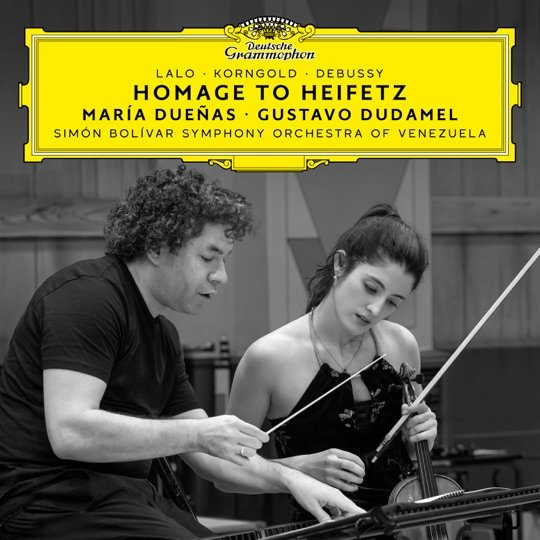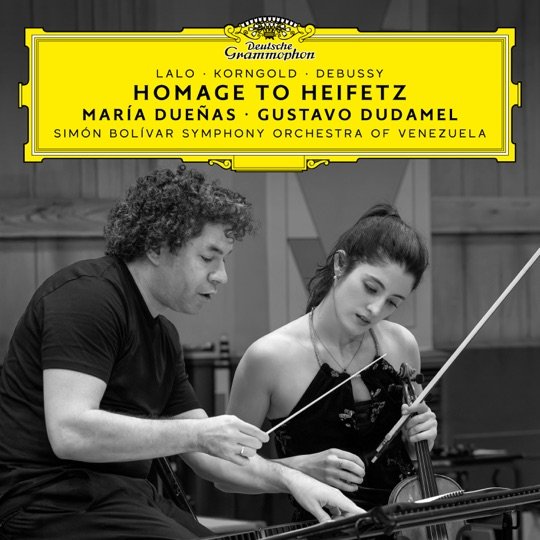

Homage. What does that mean? The PR leading up to this much-anticipated release has presented a rather simple story: Maria Duenas, age 6, became infatuated with music and the violin by listening to the family copy of Jascha Heifetz’s 1954 RCA Victor mono LP of Lalo’s Symphonie Espagnole and Korngold’s Violin Concerto. Now that she is following in Heifetz’s footsteps as one of the leading violin virtuosos of our time, she is drawing inspiration from childhood nostalgia to build her latest album release around that memory.
That’s straight forward enough, and for most purposes, enough said. By all means dive in, cue up “Homage to Heifetz” on disc, or LPs, or your favourite streamer, and enjoy! I think this is a thoroughly enjoyable album, it sounds good in both stereo and spatial audio. And if you have even a little bit of interest in great violin playing and interesting repertoire, you won’t want to miss out.
But there’s a lot more to be said. The new album, when you get right down to it, has very little to with Heifetz at all – just the bare concept, really. This is an album all about Maria Duenas, and the kind of violinist she has become. And for what it’s worth, it really isn’t much about Gustavo Dudamel and the Simón Bolívar Symphony Orchestra of Venezuela, either.
Recognizing this makes the whole project so much more interesting, in my opinion. If Duenas were a lesser artist, she might go back to those old recordings and try to recreate some of their magic or mystery with fresh fingers and ears. Instead, she seems to say, “Thank you very much Mr. Heifetz, now move over and let me have my say!” This is his repertoire filtered through an utterly foreign musical spirit – nervy, quicksilver, risk-addicted – that sits at the opposite pole from the man she is honoring.
To make this easy to hear for yourself, I’ve put together an Apple Music playlist that includes the new Maria Duenas recordings of each track, back-to-back with the Heifetz originals. I’ve put the short encore pieces at the top, since they make for clearer immediate comparisons, without needing to make allowances for the rather poor orchestral contributions from 1954. Click on the album cover to open in Apple Music:
Starting from the top, the four concert miniatures represent typical violinists’ programs of the 1940s and 1950s. Heifetz himself had an astonishing number of these baubles in his repertoire, not to mention the record catalogues. Maria Duenas offers four tasty choices from the cabinet: three Debussy pieces (one in a violin-orchestra arrangement that Heifetz wouldn’t have known), and Heifetz’s own arrangement of Ponce’s song Estrellita. It’s interesting to note that Duenas was lent a violin famously associated with Heifetz (the “Heifetz, Piel” Stradivarius of 1731) to record these pieces.
But that’s where the reflection of Heifetz’s own playing begins and ends. Are you expecting Heifetz to sound romantic and schmaltzy, while Duenas is modern and precise and cool? Not on your life!
Compare Debussy’s La plus que lente. Heifetz is the straight man, with a stand-and-deliver approach, feet planted and molten tone pouring out: there’s not a lot of rubato, his vibrato is as steady as a metronome, and he shapes phrases almost entirely by dynamics spinning a long line.
Duenas is at the far end of a spectrum. Her vibrato is rapid and constantly changing, tightening and loosening within single notes. Her moods are quixotic, swerving from a confiding whisper to raw outburst inside a single phrase. But the tell for me – and it came as a revelation to my non-violinist ears – is her bow hand. Heifetz the romantic varies color mainly by the angle of his bow to the strings, and distance from the bridge. Duenas the modern firebrand does all that, then adds in a remarkable control of weight and speed: you’ll hear her press into the string, then slow the bow to the edge of stalling, so that the tone skitters and frays on purpose. I’m sure there’s a technical name for this technique, but I don’t know it. The result is a dramatic tug on the heartstrings, something akin to sighing and sobbing.
You’ll notice this heightened emotional tension from bow control constantly, throughout Hommage to Heifetz. And now that I’ve started paying attention to it, I hear it to some degree in all of Duenas’s recent recordings.
a deliberate flutter in the stroke, where Heifetz’s 1971 studio account is one unbroken ribbon of tone. Then catch the skittering half-tone she gives Estrellita’s second phrase – set it against Augustin Hadelich’s warm, even-keeled 2024 version and the two players seem to be describing different stars. And note what she restores:
Move on to Ponce’s Estrellita, just the first 15 or 20 seconds or so will do. To make things even clearer, I’ve added another fine modern violinist, Augustin Hadelich, to the comparison. Duenas’s bow-hand tremolo, somehow combined with subtly modulated vibrato, stands apart, unmistakably, from both Heifetz and Hadelich. There’s a deliberate flutter in her bow stroke, where Heifetz’s 1971 studio account is one unbroken ribbon of tone. Then note the skittering half-tone she gives Estrellita’s second phrase, compare to Augustin Hadelich’s warm, even-keeled 2024 version, and the two players seem to be playing a different song. I begin to wonder if this is Maria Duenas’s unique superpower.
Now on to the two concertos (Symphonie Espagnole is a violin concerto in all but name). Once again, I have to question some assumptions that I brought to this listening session. I have generally understood that the Heifetz 1954 album is an iconic cornerstone of violin recordings history. It was inducted into the Recording Academy’s Grammy Hall of Fame in 2008, and it appears on any number of “Best Album” and “Top 100” lists. But the actual history is complicated.
Start with a minor point: the two concertos were originally released separately, the Lalo in 1951 (with William Steinberg and the RCA Victor Symphony Orchestra); and the Korngold in 1953 (Alfred Wallenstein and the Los Angeles Philharmonic). RCA re-issued them together in 1954 as the famed iconic LP.
More interestingly, the albums were not very well received at the time. The Korngold in particular was the target of spicy critical commentary: Irving Kolodin’s “more corn than gold” crack became notorious. This was mostly directed at the composition and its tacky association with Hollywood, rather than the Heifetz performance. But Heifetz was the concerto’s one and only champion, both on the concert stage and in studio.
The Lalo didn’t fare much better: in 1952, the influential review magazine High Fidelity suggested that Heifetz recorded it because he simply needed another record to fulfill his contract. The 1954 “value” release bringing the two recordings together was treated more gently, but now everyone started to notice that although Heifetz’s performances were terrific, the orchestras were not.
And so it went. Eventually, Korngold’s music got payback, and his Violin Concerto became the album’s saving grace. In the 1980s, other violinists and conductors of note began to program the work, it experienced a revival, and more recordings followed. The old Heifetz recording gathered weight as the original salvo in a musical cultural war of sorts. By the time Maria Duenas got her hands on the record in 2008, it was in fact a classic.
Today, I think we can ignore much of that old controversy, and accept that both of these works have their place in the modern violin concerto firmament. Rather than make movement-by-movement comparisons of the new Duenas recordings and Heifetz, I’ll just say that her performances are exhilarating, technically dazzling, and emotionally rich, and leave it at that. The Heifetz performances are compelling history, well worth a close listen, but I think most listeners today will opt for Duenas and Dudamel and Simon Bolivar.
If you are carrying on with the A-B comparisons, be aware that Heifetz didn’t record the 3rd movement Intermezzo of Symphonie Espagnole, so his recording jumps straight from the Scherzo to the Andante, and you have only four movements to consider.
I don’t need to say much about the audio production of Homage to Heifetz. The orchestral tracks were recorded at Abbey Road Studios in London, the venue for many major motion picture productions, and big-money classical recordings as well… and it sounds like it. There’s nothing to complain about, in either Dobly Atmos streaming versions, or the high-rez stereo. Dueñas is mic’ed closely enough that you’ll hear every nuance of her bow work – which for this violinist is the right call. The violin-piano tracks were recorded in a smaller studio in Berlin, with the same production team, and they fit right in: vivid, close-up perspective, the breath sounds aren’t too obtrusive, and the “Heifetz, Piel” Stradivarius sounds magnificent.
The orchestral works were taped at Abbey Road Studios in August 2025 with Simon Rhodes engineering, and the sound is vivid and forward, Dueñas close-mic’ed enough that every bow-hair event registers – which for this violinist is the right call. The three miniatures, from Berlin’s b-sharp studio, are drier and more confiding. The booklet credits Martin Kistner with an immersive mix; Qobuz carries 24-bit/96 stereo only, so head to Apple Music Classical for the Atmos version, which places the solo violin sensibly up front rather than floating it in the rafters.
So where does that leave the Homage? Exactly where it should be: a young artist proving you honor an idol best by metabolizing him, not embalming him. And the Lalo has fire to spare!
Favorite MomentBack to Top
Listen to any or all of the three violin-piano duets: La plus que lente, La chevelure, and Estrellita. They are all magnificent. In this close-up perspective, you will hear every nuance of Maria Duenas’s artistry, and you will want to wallow in the dark lusciousness of the exotic instrument (the “Heifetz, Piel” Stradivarius) she is playing.
Further ListeningBack to Top
Jascha Heifetz, Korngold: Violin Concerto / Lalo: Symphonie espagnole (RCA Victor, 1954). The inspiration for Homage to Heifetz, still widely streamable in its original pairing. It’s worlds apart from Dueñas in temperament – seamless, imperious, gently sentimental, and it’s the essential companion listen to this release. It’s worth hanging on to this link, as it’s tricky to search the Heifetz catalogue.
Jascha Heifetz, Heifetz: Encores, Vol. 1 (1946–1956) (Naxos, 2013). The piano-accompanied La fille aux cheveux de lin and La chevelure (Her Hair) with Emanuel Bay. A generous hour-long helping of Heifetz concert miniatures, well remastered for modern ears, and a better representation of the Heifetz magic than you can glean from a couple of excerpts.
Augustin Hadelich, American Road Trip (Warner, 2024). Includes the same Heifetz arrangement of Estrellita, played with golden evenness where Dueñas flickers and frays. A fascinating study in how two of today’s finest violinists approach a similar emotional goal with such different techniques.