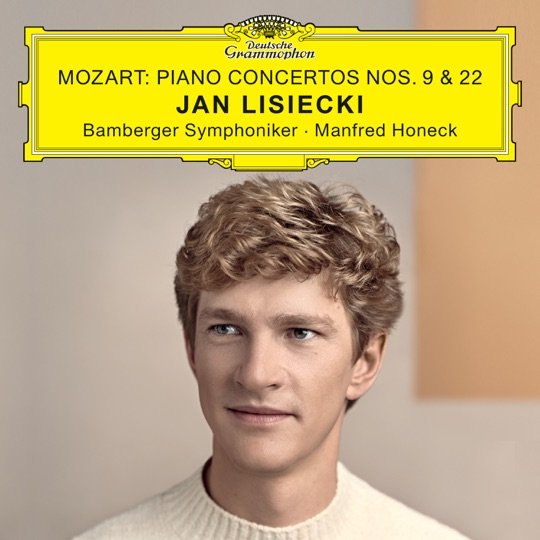

Jan Lisiecki’s return to Mozart concerto repertoire after 14 years is a welcome treat. I expected nothing less, as Lisiecki was still a teenager his last go round in 2012, and his playing has developed depth and sparkle, seemingly with every album release over the years. But I really wasn’t expecting this much!
It shows how much it matters for performers at the top of their game to find partners that really fit. I think Lisiecki would agree, as he discusses the evolution of his partnership with Manfred Honeck and the Bamberg Symphony at some length in his album booklet notes. Something certainly clicked. The 2012 edition with Christian Zacharias and the Bavarian Radio Symphony delivered fine, tasteful Mozart playing (concertos nos. 20 & 21). But this new release is something else again: fluidly alert, chamber music-style, conversational, and surprising at nearly every turn.
I imagine some listeners may feel that Lisiecki and Honneck take things a bit too far towards the romantic, or may bridle at some of the lightly revisionist liberties they have taken with the score.
To be sure, these performances are shaped by a freedom of tempo that is unusual in Mozart: Honeck and Lisiecki employ a classically tasteful rubato freely, and not just in the deeply-felt slow movements. They treat tempo as a structural tool, the push and pull is constant, subtle, and always towards an architectural purpose. Listen to how the pulse eases almost imperceptibly to set up the return of a key theme; or how a slight accelerando flags a major modulation in the development of K. 271’s first movement. This isn’t rubato as an anachronistic indulgence, I hear it as a tasteful and quite exciting response to the unusual demands of these remarkable compositions.
The programme is a well planned pairing: two E flat major concertos, No. 9 is the most compelling and innovative of the young Mozart concerti (1777, age 21), and No. 22 is the polished fulfillment of his youthful instincts as a master, eight years later. Both open and close in E flat, both slow movements in C minor are characteristic emotion-laden dramas, and both interrupt their finales with something unexpected – the ninth with a full-blown cadenza in the slow movement and the twenty-second with a courtly minuet dropped into the middle of a galloping Allegro.
There are so many more examples of Mozart’s fresh thinking here. Most famously, the piano’s immediate interruption and give-and-take with the orchestra at the open of K. 271 sets the tone for the whole work: piano and orchestra finishing each other’s sentences, trading off rather than seeking dominance. The unusual and the unexpected are compositional norms in both these works. And responding to that, the thorough-going rubato of the performance is as effective and clarifying as it is unexpected. And I must say, it is remarkable how perfectly the soloist and orchestra stay locked in a groove on their push and pull.
It’s something of a cliché to claim that a concerto performance is played “chamber music style”. And some of the PR for this release makes that claim. But it really does describe what’s going on here. Phrase endings, dynamic shading, the handoff of a melodic line from orchestra to piano and back – Lisiecki and the Bamberg players are locked together one moment, trading seamless leads the next. Following this interplay is constant joy, just as it is in a fine chamber music performance.
I alluded to some liberties taken with the score. The boldest interpretive stroke gets right at the heart of this chamber music feeling. For the C major variations in the middle of No. 22’s slow movement, and for the minuet interlude in the finale, Honeck thins the orchestra down to a solo string quintet – literal chamber music inside the concerto. It’s a very striking effect, you can’t miss it, and I can’t recall hearing this done on record (or in live concert, for that matter) before. The effect is lovely, unexpected, and still seems completely natural in context.
Jan Lisiecki’s performance is as brilliant as you would expect, if you have been following his recent recordings and concert notices. Outstanding Mozart piano. He makes some unusual choices amongst the abundant cadenza options available for these concertos, which adds to the fun. The liner notes (available online) will help you sort it all out, if that interests you.
The Bamberg winds deserve their own sentence: the flutes and clarinets in K. 482 (Mozart’s first piano concerto to use clarinets) are excellent players, singing their operatic duets with the piano exactly as Mozart must have hoped.
Now for the audio quality. The recording was made in the Joseph-Keilberth-Saal in Bamberg, with an immersive mix in Dolby Atmos spatial, and the overall picture is warm, detailed and naturally scaled to the chamber-sized approach. The piano sounds great, but I find the woodwinds are somewhat too spotlighted in the mix: the flutes and clarinets get away with it, because they are still placed in the right relationship to strings and piano, but the bassoon is strangely out of place. I’m being picky. If these things bother you, the stereo mix softens the effect. Overall, this recording is pretty well up to DG’s usual standard of excellence.
Bottom line is: this album locks in Lisiecki’s reputation as a Mozart specialist of the first rank. And I am so taken by the quality of his partnership with Honeck and the Bamberg Symphony, I pray they will carry on with additional Mozart concerto volumes.
Favorite MomentBack to Top
The minuet that interrupts the finale of K. 482 at the 4:50 mark. The full string section disappears, leaving five solo strings, and the woodwind band, playing back and forth with the piano in a pool of candlelight. It’s like a concert hall shrinks down to a drawing room in the space of a bar. At 7:00, the piano pauses, tosses off a pretty flourish, and brings the tutti surging back, the return of the Allegro now in a different frame of mind. Hang on though… it’s just a setup for the epic piano cadenza (in Mozartean terms) at 9:00. Brilliant Mozart, brilliantly played.
Further ListeningBack to Top
Jan Lisiecki, Bavarian Radio Symphony Orchestra, Christian Zacharias, Mozart: Piano Concertos Nos. 20 & 21 (Deutsche Grammophon, 2012). The DG debut, Lisiecki in his mid-teens. The playing is poised, clear and musical, but Zacharias keeps the temperature cooler… which makes Honeck and Bamberg’s freedom and flex all the more noteable. Check it out if you haven’t already, it’s still very fine Mozart.
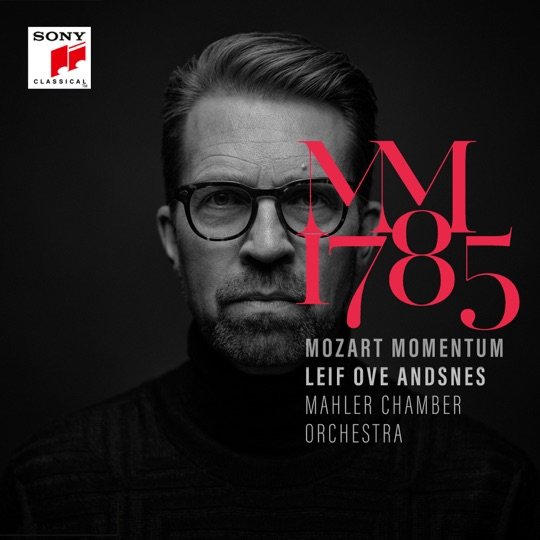
Leif Ove Andsnes & Mahler Chamber Orchestra, Mozart Momentum 1785 (Sony Classical, 2021). Andsnes treats K. 482 as part of a broader portrait of Mozart’s creative acceleration in 1785, with a leaner approach and strong forward drive. This performance is lucid and purposeful, where Lisiecki and Honeck are more conversationally elastic.
Murray Perahia, English Chamber Orchestra, Mozart: The Piano Concertos (Sony Classical, 1975–88). A great keyboard-directed complete set, and a touchstone for comparison.
And a book…Back to Top
Patrick Mackie: Mozart in Motion (Farrar, Straus & Giroux). What does a poet have to say about Mozart? Patrick Mackie’s book-length analysis treats Mozart as a composer whose genius led to music that argues, surprises, and changes direction moment by moment. Were Lisiecki and Honeck reading this during the recording sessions? See the chapter “Victoire Jenamy: ‘Jeunehomme’ Concerto [K. 271]”.