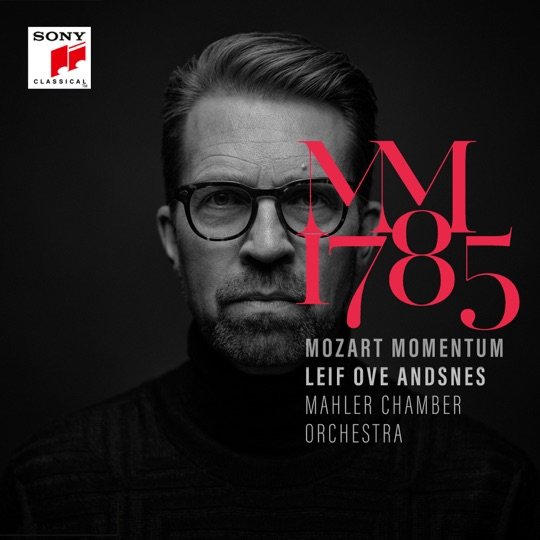

In 1785, Mozart found himself fighting for position in a Vienna suddenly crowded with talented rivals. It shows in the music, and Leif Ove Andsnes and the Mahler Chamber Orchestra get it. In these piano concertos, they bring us a Mozart who is restlessly expanding what the form could bring.
Mozart Momentum 1785 is their first installment of a two-volume project exploring the years 1785–86, with this first year representing a kind of annus mirabilis in Mozart’s creative output. In his piano concertos nos. 20 and 21, composed in February and March of that year, Mozart transforms the concerto into a major expressive form to equal the opera or the symphony. The contrast is striking: D minor turbulence followed almost immediately by C major serenity. That range, achieved in the same season for his own public concerts, is one reason why 1785 feels miraculous.
Andsnes has been here before, in a fine 2000 recording with the Norwegian Chamber Orchestra. There he showed a stylish affinity for the repertoire, engaging in a balanced conversation with the ensemble. Here in 2022 he finds a heightened kind of chamber music attentiveness: winds foregrounded, string vibrato used sparingly, accents deployed with historical-practice sharpness that never tips into fussiness. This brings the drama of the D Minor concerto into full focus.
That concerto, K. 466, is the album’s most revealing test. His cadenza choices are interesting: Beethoven for the first movement (stern and elemental), Hummel for the finale (fleet and chromatic). Together these choices mark out the concerto’s uncomfortable position between Mozart’s classical world and the romantic storm that would follow.
The C major Concerto (K. 467) benefits from the Mahler ensemble’s precision and clarity. The oh-so familiar Andante of film score fame, which can often sound syrupy and languorous, moves with a compelling pulse, and the piano enters with purposeful intent, rather than sentimental sweetness.
The non-concerto works are not filler. The Fantasia in C Minor (K. 475) is darkly dramatic, and Andsnes brings it an operatic volatility that suits it well: this is not drawing-room Mozart. And the G minor Piano Quartet (K. 478), with Mahler Chamber Orchestra principals Truscott, Hunter, and Guthmann, is a highlight of collegial chamber playing. The first movement is properly unsettled, the slow movement is tenderly hesitant, the finale bright and confident.
The themed programming of Momentum 1785 is effective, and bodes well for the promised Momentum 1786. Bracketing the concertos with the Masonic Funeral Music and the Fantasia, both in C minor, gives the whole project a tonal and emotional coherence that rewards listening straight through rather than track by track.
Favorite MomentBack to Top
The slow movement of K. 482, the E-flat Concerto, is a set of variations in C minor. About two-thirds of the way through, the woodwinds take a variation alone, and the texture thins to almost nothing, just the winds in a long, hushed passage before the piano re-enters. It is one of those passages in Mozart where beauty and desolation merge, and Andsnes makes it sublime.
Further ListeningBack to Top
Murray Perahia / English Chamber Orchestra (Sony, rec. 1975–1982) A natural comparison, part of a complete concertos box. Perahia’s take on these particular concertos with the ECO remains a benchmark of sorts, but warmer in tone, and less concerned with period-practice inflection. Check out K. 467, Perahia’s slow movement breathes freely, while Andsnes’ sense of pulse keeps the music more grounded and purposeful.