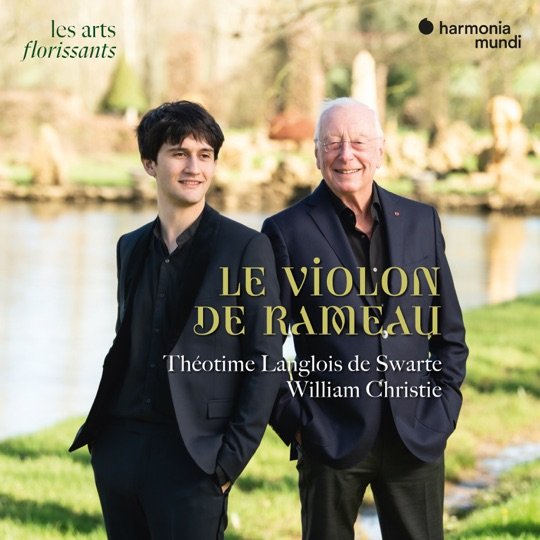

Naming this album “Le Violon de Rameau” is a bit of a joke. Jean-Philippe Rameau never wrote a note for solo violin: we have plenty of Rameau for solo harpsichord, but he left us no compositions at all for the violin – not a sonata, not a concerto, nothing. Yet he is said to have been an excellent violinist and to have composed with a violin in his hands. One of the few portraits we have of him shows the composer with violin, plucking a string, with the bow laid aside on the table.
From that image, Théotime Langlois de Swarte and William Christie have created an imaginary world where the violin might have been Rameau’s favourite solo instrument. The repertoire is drawn mostly from an eighteenth-century manuscript of violin airs and dances transcribed from Rameau’s operas, interspersed with short movements they have dug up by several violinist-composers who were his colleagues in the orchestra pit.
The music curation is a real achievement. They keep Rameau at centre stage, with blocks of music drawn from the operas Castor et Pollux, Les Indes Galantes, and Hippolyte et Aricie, plus a selection each from Dardanus and Les Fêtes d’Hébé. In between, they drop in little groups of pieces by forgotten names like Théodore-Jean Tarade, Jean-Baptiste Cupis, André-Joseph Exaudet, and Charles-Antoine Branche (double-barrel first names must have been a thing). Keys and tempos of short pieces exerpted from disparate sources are laid out as dramatic scenarios: a gavotte for the slow awakening, a dotted-rhythm air for the rising curtain, birdsongs, a folk tune. There is one complete five-movement violin sonata, by Louis Aubert. The result is a remarkably coherent narrative flow: “we wanted to plan a virtual musical journey, to tell a story that would run through the whole programme” de Swarte tells us.
The musicians have taken liberties with the music – making cuts, creating segues, running wild with ornamentation – with no apologies, and none needed. They have also chosen to do without cello or viola da gamba providing a bass line, and Christie compensates by beefing up his left-hand work on harpsichord and organ. He also provides substantial improvisations to create transitions within the programme.
And it all works… because they play with the nerve and energy the concept requires. Christie says in the booklet that he occasionally had to rein de Swarte in, and you can certainly hear what he means – ornaments are plentiful, tempo is elastic, and passagework is sometimes frenetic. Christie’s own contribution is quieter, but equally colourful and imaginative: I particularly enjoy his choice of a 4-ft stop for the “Rossignol” Air from Castor and Pollux, where the crystalline high register of his harpsichord inverts the roles of lead and accompaniment (track 8).
The fantasy concept of the programme carries over into the audio production. The program booklet promises “refined and intimate,” and that is surely what the performance presents: opera stripped down to two players, the violin taking lines that once belonged to a whole theatre orchestra. But does it sound intimate? Not on your life! It’s quite a shock to start listening, and find them apparently situated in the nave of a huge church, enveloped in a soupy, reverberant acoustic. The music tells us we’re in a stately drawing room. The recording says it’s Notre Dame Cathedral!
I was put off by this at the first listen: the washy reverb-rich audio environment struck me as completely wrong for the repertoire, and my expectations of a violin-keyboard recital of French Baroque. But before long, I realized what was going on. The taking of liberties extends as much to the audio production as to the performance mannerisms. The recordings actually took place in three separate locations over a period of seven months, but the album presentation coalesces this all into a single unified – and frankly, fabricated – acoustic space. The generous reverberation required to accommodate the crucial inclusion of the Boizard organ of 1714 at Saint-Michel-en-Thiérache, about 200 km from Paris where most of the recording took place.
In the Christie/Les Arts Florissants world, this organ is uniquely suitable for Rameau. It is one of the few French classical organs to survive from Rameau’s day, essentially intact, still at its original pitch a whole-tone below modern. It is maintained to this day with its distinctive tuning to Rameau’s own preferred variation of meantone temperament (as opposed to modern equal temperament).
Now, if you want to use that particular organ for its distinctive flavour, everything else involved in the recording project has to be adjusted to align with the Boizard, its tuning, and the generous acoustics of its Benedictine abbey church in Picardy (which has been the focal point of an early-music festival since 1987).
The dominoes fall: the violin/harpsichord sessions must be matched for seamless segues with the Boizard organ sessions – pitch and acoustics first and foremost. The opulent reverberance of the finished album is a reasonably successful way of dealing with the acoustics issue: I suspect some judicious use of simulated delay and reverb technology to create consistency across all the recording sessions.
Another knock-on effect is the more subtle management of tuning and temperament. I won’t even try to catalogue the peculiarities of Rameau’s well documented 1726 modified-meantone temperament, in which not all keys are created equal (and which he abandoned for equal temperament by 1737!). But the (meantone) organ and (equal-tempered) harpsichord are never heard together, audio wizardry papers over the transitions, and Langlois de Swarte comfortably adapts his pristine intonation to whichever instrument accompanies him in the moment. The net result is that we enjoy the characteristic piquancy of the organ, without souring the sweetness of the violin-harpsichord heart of the programme.
I will still quibble on behalf of the audio purist: the soundstage is unquestionably artificial sounding, with the keyboard accompaniments mic’ed closely to offer clarity and bottom-end weight, while the violin soars above with unfettered spaciousness… they don’t really sound like they are in the same room.
Argue with the room if you like: this is a wonderfully musical and enjoyable fantasy of Rameau and his violin, staged in a venue of the imagination, and I recommend you visit soon. Spatial audio listening in Atmos is definitely recommended (all the reverb is a bit much in stereo).
Favorite MomentBack to Top
Let me give you two. Track 2, a sonata movement by Jean-Baptiste Cupis, starts with a Grave played with a bold registration on the distinctive Boizard organ. Then at 1:30, the violin enters, the organ shifts dramatically to a gentle flue stop, and they play a sweet and wistful duet through to the end. And then Track 7, an Air by Toussaint Bordet (“The Nightingale’s Sweet Song”), very much in the manner of Rameau’s best keyboard character pieces (such as “Le Rappel des oiseaux“). Here, Langlois de Swarte carries the main tune, while Christie’s ornamentations in the upper register of the harpsichord make the birdsong soar to the heavens. It’s a lovely and unique reversal of the instrumental roles.
Further ListeningBack to Top
Théotime Langlois de Swarte and William Christie, Générations: Senaillé, Leclair (Harmonia Mundi, 2021). This is Christie and de Swarte’s first exploration of the same violin-and-harpsichord format, similar sharply-judged programming, but focused on reality: Leclair and Senaillé were France’s leading violinist-composers of Rameau’s time. If you haven’t heard Senaillé, don’t miss this.
Théotime Langlois de Swarte and Thomas Dunford, The Mad Lover (Harmonia Mundi, 2020). English seventeenth-century repertoire with lute rather than French and keyboard. I like this for the improvisation and freedom. Listen for the sheer appetite for risk that William Christie describes in the Rameau booklet… caught earlier and with fewer restraints.
William Christie and Les Arts Florissants, Le Jardin de Monsieur Rameau (Les Arts Florissants Éditions, 2014; Harmonia Mundi reissue 2018). Completely different musical concept, opera highlights of Rameau’s contemporaries, but it’s the same curatorial imagination, assembling a portrait out of fragments, making a nice companion piece.