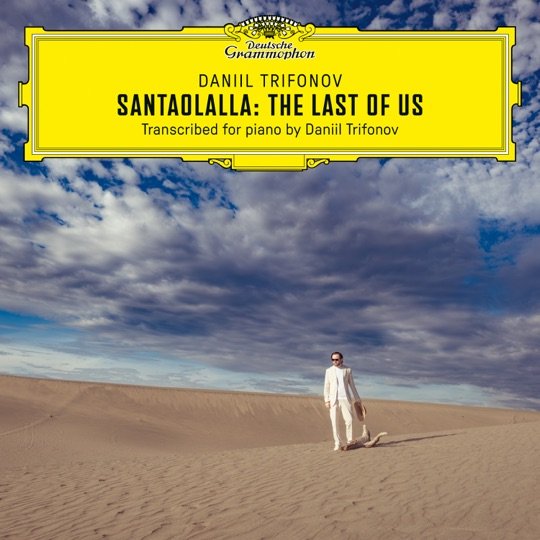

I’m unreasonably excited about Daniil Trifonov’s latest streaming single, released today by Deutsche Grammophon. He performs his own transcription of the iconic game franchise theme music from the smash hit, post-apocalyptic thriller, The Last of Us. Nothing too special about that, you might think: lots of pianists are playing video game, film and TV music these days. Although… not many are in Trifonov’s elite echelon.
But check it out here, and see if you share my enthusiasm:
Santaolalla: Theme from "The Last of Us" (Transcr. Daniil Trifonov)

This is Trifonov’s take on the haunting and instantly recognizable leitmotiv and theme that upstart composer Gustavo Santaolalla created for his first major video-game score, The Last of Us, in 2013. The game became a franchise best-seller, spawning a sequel, and then two seasons (so far) as one of HBO’s biggest hits… fueled by this theme and Santaolalla’s elaborations upon it. As you can hear, Trifonov has not simply adapted the music for piano. He has dissected it and re-assembled it with intriguing imaginative flair, as a re-mix artist, or an electronic composer, might do. With my mix engineer’s hat on, I can hear at least four distinct layers here, probably more: the close mic’ed piano front and center; two layers – maybe 4 or 5 – of transformed counter-pointing piano parts with reverb and spatial positioning warps, maybe some pitch shifting too; and then a layer or two of inside-the-piano work (plucked and muted string effects) that recalls the guitar-like original soundtrack elements.
This isn’t Trifonov’s first toe dipped into the waters of studio craft. In 2024, he released a series of digital singles, starting with his own piano transcription of “Secunda” from The Elder Scrolls V: Skyrim, revealing his interest in treating contemporary film and game music as recital repertoire. That was followed by a succession of standalone digital singles, including “China Gates” (John Adams), and “American Beauty” (Thomas Newman), as previews for his album My American Story: North later in the year. Those releases were essentially straightforward solo recordings.
John Williams: Man of the House (Arr. Trifonov for 2 Pianos) (From "Home Alone")

A turning point came at the end of the year, when Apple Music Classical commissioned Trifonov to contribute a track to Carols Covered, a holiday collection in which leading artists created original reinterpretations of seasonal favourites. His contribution, “Man of the House“, was an arrangement by Trifonov for two pianos. The twist was that, for the recording, he played both piano parts himself and assembled the parts through multitracking in the studio. And today, we see where that has led.
Trifonov’s transformative studio work today has leap-frogged by a wide margin the naive piano noodling that sets my teeth on edge when it shows up as “recommended single.” The Last of Us is one of the most listenable and interesting classical singles I have heard from a major label in some time.
And it gives me hope that there will be more to follow. I wonder, for example, if Trifonov might follow the path of Glenn Gould. Gould was certainly a pianist at Trifonov’s level, to say the least, and he famously moved on from the live performance grind to focus his creative energy on the recording studio. Many today have forgotten that Gould’s studio preoccupation Included far-reaching experiments with multimedia, multi-layered sound collages and film projects. Is this the direction Daniil Trifonov is leaning?
The Idea of North is part of Gould’s Solitude Trilogy, the first of his “contrapuntal documentaries,” broadcast by the CBC in December 1967. Unlike a conventional documentary, it layers multiple recorded voices into a kind of spoken counterpoint, a technique Gould thought of as the recording studio’s equivalent of musical polyphony.
That might be a bit too far out for today’s artists. Some other quality modern examples that more or less line up with Trifonov’s latest work include Max Richter, Stephan Moccio, maybe Gabríel Ólafs. Let me round out today’s playlist with a few more examples that suggest where we may be headed… fingers crossed!
Max Richter: Recomposed by Max Richter: Vivaldi – The Four Seasons (Deutsche Grammophon, 2012)
Richter’s Recomposed releases are an obvious forerunner in studio process applied to classical repertoire. He dismantles the familiar material, layers and rebuilds it using the producer-composer’s techniques and ear.