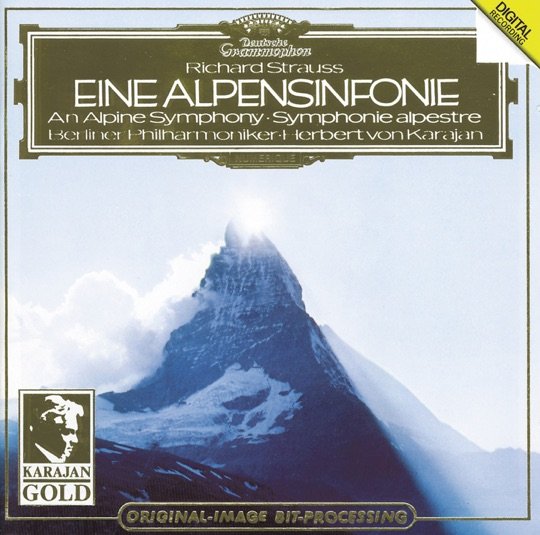

Decision time: do I still need my much-played CD copy of Herbert von Karajan’s 1980 recording of Strauss’s Alpine Symphony (Eine Alpensinfonie)? Or can I happily toss it, as I weed out the collection, and rely on streaming services going forward?
This is a historically significant recording. Karajan had signed on as an ambassador for the nascent CD format in 1979, before the format was even settled. This performance, captured on multitrack digital tape in December 1980, was the source for one of the first compact disc test pressings, unveiled by Karajan himself at a Salzburg press conference in April 1981. As an ever-enthusiastic advocate of new technologies and media, Karajan declared the new digital format an advance comparable to the arrival of electric lights over gas lamps. And Karajan’s insistence on sticking with multitrack recording through the digital transition, in spite of all technical obstacles, is the reason a satisfying spatial mix is possible today. He was planning for a future most of the industry couldn’t yet imagine.
The LP pressing followed that press event just a few months later, in 1981. The label on the vinyl disc was marked with the new “DDD” symbol to indicate a fully digital production. The truly digital CD version – which DG today touts as “the first mass-produced CD” – arrived in early 1983. And today, the same multitrack masters have been used to create a state-of-the-art spatial audio remix, which arrived on streaming services in the first wave of Atmos releases on Apple Music in 2021.
My own shelf copy of the CD is DG’s re-issue in their Karajan Gold series of 1993. It’s a remix and remaster that takes some of the rough edges off of the admittedly harsh, over-bright first-generation digital sound of the 1980’s vinyl and CD album versions. And I’ve been happily enjoying that 1993 disc ever since.
There’s more to the story. In 1980, Karajan was twenty-five years into his Berlin tenure, 72 years old, and acclaimed as one of the great Strauss conductors of the century. Yet he had somehow never gotten around to recording the Alpine Symphony. This is his only studio recording of the work. He went on to perform it some twenty times in concert through the 1980s, and never conducted it with any other orchestra.
All of this history leaves me with mixed feelings about keeping the CD in my collection. The distinctive digital sonics of the stereo version, even tamed and refined for the 1993 edition, were never the reason for cherishing this album. Plenty of competing versions delivered impressive performances and sounded good. What sets Karajan’s Berlin performance apart from all the rest is its durability: it keeps delivering a sweeping and compelling musical journey every time you listen, where lesser accounts run out of steam after one or two plays.
Listen to the first sunrise: the brass arrives shining with a white-hot glare, while upper winds and violins sharpen the edge until the orchestra seems to lift right up out of the night. Magnificent! Karajan never lets his Alpine spectacle turn into a sequence of colorful vignettes. The mountain may be decked out in gaudy colours, but the route across it remains taut and compelling. There are occasional moments where ensemble edges blur, some bobbles in the lower strings. But those moments are quickly forgotten as the performance gathers momentum and carves its narrative arc.
Needless to say, I don’t want to be without this great recording, in some form. So how about the Dolby Atmos streaming version? The good news is that it sounds great. At the very least, we can agree that it’s a generational improvement on the 1993 remix. The Deutsche Grammophon engineering team have clearly done a thorough restoration around the dated digital audio; they have rebalanced the mix to address at least some of the bottom-end deficiencies of earlier versions; and I believe they have improved the gentle added reverb with the latest spatial-friendly equipment and great skill. The result in full Atmos sounds pretty wonderful.
But this is the rare case where the physical object is itself a kind of museum piece. I imagine one day I will want to A-B test the 1993 CD against its Atmos transformation, just for old time’s sake. And there’s the jewel case, booklet and all. Selling it off would be like selling a valuable penny-black postage stamp just because email came on the scene. The disc stays… but I’ll be listening via streaming.
Favorite MomentBack to Top
[It’s hard to resist the massive storm scene (track 19), which benefits greatly from the dramatic surround sonics. But I’ll steer you towards the epilogue (Ausklang) instead, with it’s glowing beauty. Start from track 20 and continue on into the epilogue and return of night that ends the Symphony. Great performance, great payoff!
Further ListeningBack to Top
Edward Gardner, Strauss: An Alpine Symphony and Metamorphosen, London Philharmonic (London Philharmonic Orchestra, 2026). An obvious comparison: new release (June 2026) in the latest of sumptuous spatial audio, without the over-bright harshness of DG’s first-generation digital. However, the performance makes me think of a second-rate movie soundtrack, all surface, no substance, plus gimicky spatial effects.
Georg Solti, Strauss: Eine Alpensinfonie, Bavarian Radio Symphony Orchestra (Decca, 1979). Analogue-era spectacle from the label that knew how to record thunderstorms. Solti’s peaks are more granite than fire, and the Decca engineering remains a benchmark the pre-digital era.
Semyon Bychkov, Strauss: Eine Alpensinfonie, WDR Sinfonieorchester Köln (Profil, 2009). A more deliberate, gracefully phrased ascent that rewards attention in the quiet scene-painting. At the summit, the WDR orchestra delivers a bass-brass foundation the Berlin recording barely hints at. It works, after its own fashion.