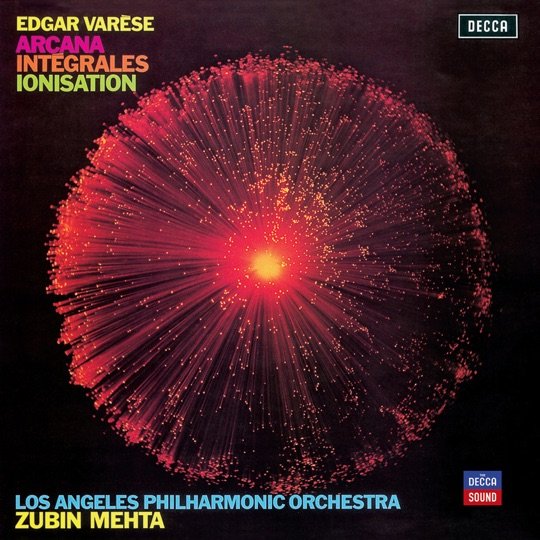
Writing about Zubin Mehta’s 1972 all-Varèse album yesterday got me thinking about why I was so infatuated with Varèse back then. There were two things that stood out for me. First, the way he thought and composed music with the primary focus on big architectural blocks and planes of sound that created structure and narrative – this is what historians and music theorists always talk about with Varèse. Second, and I think more important, I responded to his aural imagination, which was concerned with sound as objects and colours, more than about melody, harmony, or even rhythm in the traditional sense. In short, he was an electronic musician before electronic music existed.
This culminated in the spectacular Poème électronique, which he composed for the Brussels world fair of 1958, generally known as Expo 58. In one short summer he became the most widely heard electronic music composer of the time, a distinction that held for at least a decade, until he was bested by Walter Carlos’s Switched On Bach in 1968. But his journey to Poème began as early as 1930-31, with Ionisation, premiered in 1933.
Edgard Varèse – Ionisation, conducted by Nicolas Slonimsky, June 1934 (Columbia "Blue Wax" 10" shellac, 4095-M)
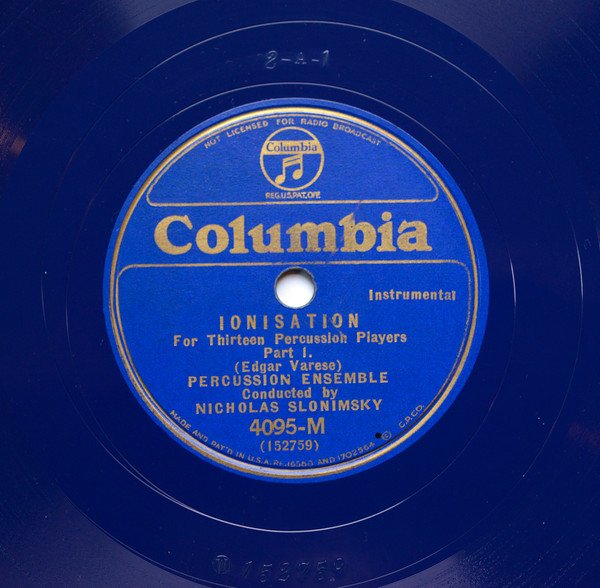
The premiere performance took place in New York, at Carnegie Chapter Hall, early March of 1933, conducted by a youthful Nicolas Slonimsky. The performance caused a scandal (as new music of importance often did in those days), one attendee said it was “a sock in the jaw.” Several more raucous performances, and a year later, Slonimsky was at Columbia’s Fifth Avenue recording studios in Manhattan to record Ionisation, with Varèse himself allegedly performing the siren part, along with a crackerjack ensemble of composers and percussionists. This wasn’t just the premiere recording of Ionisation, it was the first commercial recording of any Varèse composition. Imagine hearing this thin-sounding 78 rpm back then, an exotic brew of ringing metallics, woody blocks and rasping rattles, brassy gongs, noisemakers, and sirens. The only familiar musical sounds: a persistent military drum, and then a few subtle pings from a piano, some bells, and a glockenspiel at the very end. Imagine all this, without ever having heard a synthesizer or musique concrete. Sounds like electronic music, doesn’t it?
Edgard Varèse – Ecuatorial (1934), Ensemble intercontemporain (2012)
By 1934, Varèse had access to an actual electronic instrument, the “Fingerboard Theremin” (an early variant of the radiophonic theremin that is famously played by waving hands in the air around a pair of antennae). He eagerly adopted the new instrument and composed Ecuatorial (for chorus or bass voice, brass, organ, percussion and theremins). He revised the score in 1961, replacing theremins with the more playable (and louder!) Ondes-Martenots. That’s the version you hear in this Ensemble Intercontemporain performance. The Ondes is the group of wooden keyboard and resonator/speakers in front of the ensemble on the right.
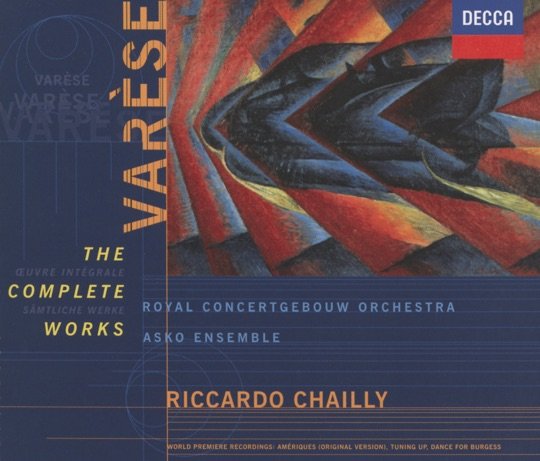
Edgar Varèse – Déserts (1954), Riccardo Chailly / ASKO Ensemble<br>
By 1954, technology caught up with him, and Varèse could finally work on tape, musique concrete or “organized sound” as he put it. For Déserts, he created extended tape “interpolations,” working in the 1950s at Pierre Schaeffer’s studio in France, at Radiodiffusion-Télévision Française; and later revised at the Columbia-Princeton Electronic Music Center in New York, 1961. The tape blocks were inserted into the live performance, alternating with blocks of ensemble live performance (scored for winds, piano and percussion). This is a 1997 performance, with Riccardo Chailly conducting the ASKO Ensemble, using the Columbia-Princeton version of the tape interpolations.
Iannis Xenakis – Concret ph (1958)

And so we come to the World’s Fair of 1958, the Philips Pavilion in Brussels, a purpose-built multimedia performance building designed expressly to house an insanely ambitious art work. It was designed by Varèse, his erstwhile student Iannis Xenakis, and the architect Le Corbusier. First, the audience moved into an entrance lobby, where this short electronic tape piece Concret ph by Xenakis set the scene (and expectations!). And then they were ushered, several hundred at a time, into a futuristic theatrical space where a collage of psychedelic imagery was projected on all surfaces, timed with precision to Varèse’s music. 350 loudspeakers were arrayed throughout the space, enabling complex multi-channel projection. There was even a bank of subwoofers like you would see at a 21st-century stadium concert. All this working in concert to create an experience like no one had ever seen or heard before on earth. This video presentation offers a selection of imagery associated with the multimedia spectacle. There have been more elaborate attempts in the 21st century to re-create the Poème électronique experience, but nothing has come close to the original!
Edgard Varèse & Le Corbusier – Poème électronique (1958)