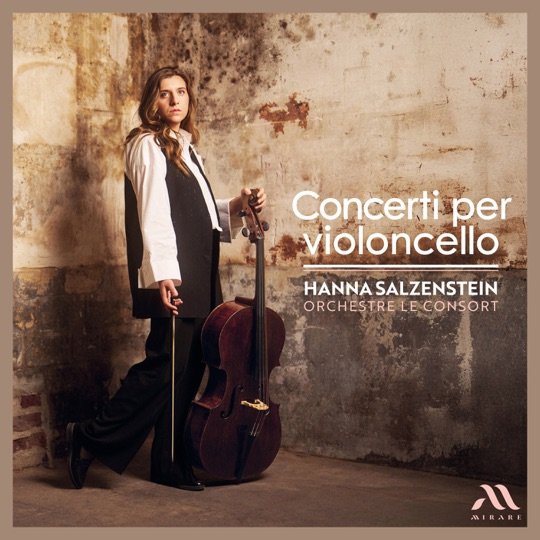

The headline on this disc is the programming. Not since a few choice entries in Sol Gabetta’s Il Progetto Vivaldi series has a baroque cello release arrived with a similarly interesting concept threaded through it. Soloist Hanna Salzenstein spent long months in the archives putting together a lineup of both rarities and more familiar fare, designed to trace the emergence of the cello concerto from its Bolognese origins with Domenico Gabrielli through the post-Vivaldi generation associated with Venice. It shows us how the instrument carved out its identity, and established the footings of the cello concerto as a form.
Salzenstein is a core member of Le Consort, the Parisian ensemble that has made archival rediscovery something of an artistic signature. The orchestra supporting her for this starring turn is Le Consort expanded to concerto-scale. They are recorded at the Église Évangélique Allemande in spacious Dolby Atmos sound: captured with a well-balanced bloom that serves the chamber orchestra textures well.
The program includes three world-premiere recordings, and they are eye- and ear-openers, upending my usual suspicion that unknown Baroque concertos probably deserve their neglect! For me, the real find is an anonymous Venetian concerto, discovered and brought to light here from the Bibliothèque nationale de France. It’s quite some discovery, with dramatic orchestral writing that plays up stark rhythmic contrasts, plus a slow movement of disarming tenderness. It sounds something like Vivaldi at his most concentrated, with unexpected asymmetries and obsessive rhythmic motifs that entice you to listen again immediately.
Giovanni Benedetto Platti’s unpublished concerto in D major is the other standout. This is a work of sunny, pastoral serenity where the solo cello converses with the violins across an unusually expansive slow movement. The writing is simple, but the emotional clarity is compelling.
Salzenstein dived into the archives again, this time the Library of Congress in Washington, with an assist from a Le Consort colleague who scanned and sent the manuscript pages to her in Paris. This is a later work by Giorgio Antoniotto, a concerto with an engaging character of its own, including a minuet finale that is distinguished by an unusual bassoon-and-cello duo that the composer seems to have added as a last-minute brainstorm (we know this thanks to Ms. Salzenstein’s extensive and entertaining liner notes).
The rest of the program is mostly Vivaldi, three concertos that show he really was the master of the form. The concertos are well chosen, and while they aren’t rarities, you don’t exactly hear them every day either. RV 401 in C minor has a dark, inward character, quite distinct from the more familiar RV 400 in C major, which is more majestic and rhetorical. They sit comfortably in the programmatic line-up rather than dominating it. The most familiar to most will be RV 503, rightly famous and admired for its rich scoring for two solo cellos. This one is right up there with Vivaldi’s greatest hits, it reminds me of his Four Seasons.
Salzenstein and Le Consort play with elegance and well-informed style, also plenty of energy and enthusiasm. They also lean towards emotional restraint, particularly in some of the more intimate slow movements, and I found myself wishing they would cut loose and let the music soar.
I mentioned the liner notes, which are available to read on streaming services that offer booklets. These demand a caution: Olivier Fourès’ essay and Salzenstein’s own lively notes are intelligent, witty, and worth a good read. But only in the original French. The English translation is a bit of a disaster, riddled with mis-readings that render passages meaningless. The most triggering gaffe for me was the repeated mention of “solar” qualities in the music, which really meant “sunny” moods. They’ve also got a detail or two like track timings out of whack. Read the French if you can, or get out your favorite chatbot to translate.
Favorite MomentBack to Top
The anonymous Venetian concerto’s second movement is the kind of slow movement that makes you put down whatever you’re doing, sit up and pay attention. There’s a particular moment where the solo cello, after the orchestral strings have set up a quietly aching harmonic bed, drops into its lowest register with a phrase of limpid simplicity. Salzenstein holds it without hurry, letting the line breathe, and for a few seconds the identity of the composer feels entirely irrelevant.
Further ListeningBack to Top
Le Consort, Théotime Langlois de Swarte: Concerti per una vita (Harmonia mundi, 2024) Here’s another intriguing program with Le Consort, this time led by their director, and playing at full throttle. Each concerto tells a different story about Vivaldi, his character, his life, his passions. And world-premiere recordings… again!
Sol Gabetta: Il progetto Vivaldi (Sony / RCA Red Seal, 2007). For a Baroque cello concerto set with equally persuasive archive-digging enthusiasm, but more extrovert energy, this makes a good pairing. Gabetta’s gut-string playing has fire and momentum, and the I Sonatori de la Gioiosa Marca ensemble keeps up with her every step of the way.