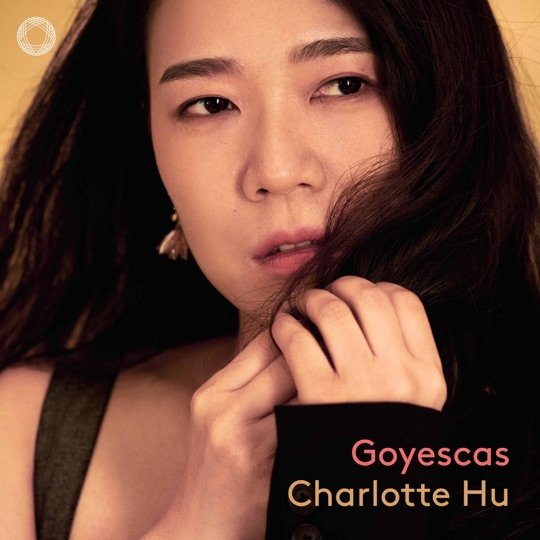

I won’t say that Enrique Granados’ two volumes of Goyescas, piano suites inspired by Goya’s paintings, are outright neglected in the recordings landscape. But given that these vivid character pieces are significant icons of 20th century piano repertoire, there is surely room for more – and more varied – choices. Enter Charlotte Hu, top prizewinner at the 2008 Arthur Rubinstein Competition, who has risen to the task.
The conventional wisdom runs like this: we have Alicia de Larrocha, and who could possibly need anything else. And it’s true that we have a great deal of Larrocha. She left at least three complete sets across her long career: on Spanish label Hispavox in 1963, Decca in 1976/77, and the Grammy-winning RCA remake of 1990. Yet across that thirty-year span her conception barely shifted. I love the appropriate stylishness of her playing, especially the rhythmic flair, and cocquetish yet restrained rubato that conjures a vivid image of Spanish dancers in full flight. But it would be ridiculous to suggest that hers is the only way to approach the music.
Hu makes the case for a different reading in her booklet notes. As a student at Juilliard, she tells us, she was drawn to the music’s poetry, characters, narrative arc, and emotional depth. And that’s how she plays it. Where Larrocha gave us brilliantly charming dances full of rhythmic character, Hu offers sumptuous tone poems full of colour, contrast and evocative moods. Put it this way: Larrocha conjured a folkloric travelogue, while Hu takes us on a languorous journey in the hot sun.
There is no reason to quibble about the quality of pianism. Hu has an excellent touch for timbral colour and shading, and she applies it with taste and imagination. This strikes me as key to unlocking an extra layer of depth in the interpretation, given that Granados was responding in the first place to powerfully emotional paintings. She also has fine command of articulation, and she uses it to good effect, bringing out melodies within complex soundscapes that other pianists don’t seem to find. I enjoy this a lot, but your mileage may vary.
If you are expecting a rhythmic pulse a dancer could actually follow (a virtue often ascribed to Larrocha’s venerable touchstone recordings), you may find Hu’s freedom a tad frustrating. Her rubato is lavish, her phrases stretch and contract. This is a performance about atmosphere and storytelling rather than rhythmic energy.
The two Danzas Españolas make a neat addition to the program. ‘Oriental’ is not so much a dance, more like a meditation, and Hu lets it breathe. ‘Andaluza‘, the famous danza that guitarists love to poach, comes into its own as piano showpiece. Together, they are a welcome deeper dive into the same world the Goyesca suites explore at length.
Soundwise, I’m very glad to have this music in excellent sonics (Dolby Atmos spatial, where available). Larrocha’s 1990 Grammy-award winning RCA set still sounds great (the 1977 Decca less so), but this Pentatone release sounds better. And it captures Ms. Hu’s range of timbral shading and dynamic phrasing perfectly.
What’s not to like?
Favorite MomentBack to Top
I always sit up and take notice when Goyesca No. 4 ‘Quejas o la Maja y el Ruiseñor’ comes around (the inspiration for “Bésame mucho“). This is a piece that separates pianists of uncommon ability from the merely competent. The nightingale’s filigree at the close can sound like a technical exercise, but Hu voices the bird’s song so that it floats free of the harmony beneath, then lets it dissolve into a question left hanging in the Mediterranean air. It’s a moment of beauty that epitomizes Charlotte Hu’s command of colour and emotional persuasion.
Further ListeningBack to Top
Alicia de Larrocha Plays Granados (RCA, 1990). The historical reference point, and still a benchmark for native rhythmic instinct and idiomatic richness. Or opt for Larrocha on Decca, 1977, also a fine performance but offering rather peaky, over-bright sonics.
Garrick Ohlsson, Granados: Goyescas and Other Piano Music (Hyperion, 2012). For something completely different (!). Ohlsson gives the suite a huge tone and a sense of tragic weight, treating it almost as a Lisztian cycle. Very fine piano sound, in keeping with the grandiose interpretation.