
There is an art to programming a disc that ranges across ten centuries without sounding like a curated playlist. Owen Park of Gesualdo Six has a proven knack for this.
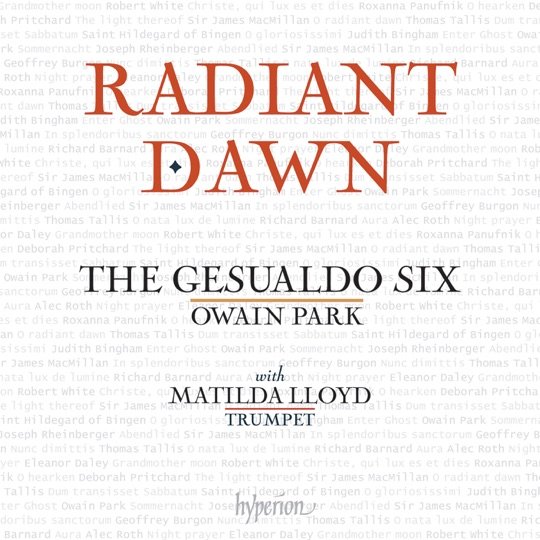
Park and The Six have been refining this art across ten Hyperion releases, and their most recent effort, Radiant Dawn, is perhaps their most successful yet. It’s quite a trick to bring a twelfth-century Hildegard of Bingen antiphon and a 21st-century James MacMillan motet together as neighbours, rather than polite strangers sharing a bench.
The programmatic concept is elemental light. Light in all its registers, from solstice-warm summer dusk through moonlight, to the blazing radiance of Advent. And the realization here is really quite brilliant. If you have any interest at all in eclectic small-ensemble choral work, this is well worth your time.
How do they bring such a wide-ranging repertoire together in cohesion? They weave a thread of plainchant through the sequence of works as a structural spine. When a chant leads into Tallis’s O nata lux de lumine, with its tangle of tricky twists suggesting light refracted through a prism, the effect is to establish a grounding connection with the next piece. When the next chant opens onto MacMillan’s O Radiant Dawn (the Motet that gives the album its name), the shared affect of the introductions makes the connections clear. We sense, without reading the program notes, that MacMillan absorbed Tallis, Tallis absorbed plainchant, and the chain of inheritance is audible in real time.
The Gesualdo Six are not a homogeneous ensemble in the sense of smoothing every individual voice into a collective blur. Two countertenors, two tenors, baritone and bass: each voice retains something of its own colour, and Park uses that variety to differentiate the layering of polyphony with unusual transparency. In Tallis’s Dum transisset sabbatum, phrases emerge from the texture and dissolve back into it with a naturalness that must be borne of singers who have spent a long time listening to one another rather than simply coordinating. The group’s precision of intonation is extraordinary as always, and their control contributes to the expressive heft of their performances.
What distinguishes this disc from its siblings in the Gesualdo Six catalogue is the addition of trumpeter Matilda Lloyd, who joins in roughly half the selections. I’m not so sure this is always a plus. Lloyd is a player of real character and precision, and in MacMillan’s In splendoribus sanctorum and Judith Bingham’s Enter Ghost, her contributions are very welcome. The brass writing here is angular, questioning, old and new simultaneously, and Lloyd rises to the moment. But in a handful of quieter, more inward tracks, her presence can feel like an intrusion into an acoustic world that was already complete. When the six voices alone are navigating Hildegard’s O gloriosissimi, with its searching melody descending repeatedly just short of its final note before resolving upward, the addition of brass, however sensitively played, must feel like an intrusion.
The modern works demonstrate both the strengths and limits of this kind of programming. MacMillan is in his element here, although perhaps an overly-familiar voice in contemporary choral repertoire. His Strathclyde Motets glow with the authority of a composer who has spent forty years learning how to make modern harmonic language feel inevitable inside a liturgical frame. Owain Park’s own Sommernacht is quietly lovely, all luminous chords and soft landing. Deborah Pritchard’s The Light Thereof and Richard Barnard’s Aura are less memorable. Arlene Roth’s Night Prayer and Eleanor Daley’s Grandmother Moon, the latter setting a Mi’kmaq text of real beauty, add breadth to what might otherwise risk becoming an exclusively Anglo-Catholic soundworld. And Geoffrey Burgon’s 1979 a cappella Nunc dimittis brings the disc to a close with something approaching serenity.
The recording, made at All Hallows, Gospel Oak, is warmly spacious without blurring the ensemble’s characteristic transparency. Hyperion’s engineers have placed the singers close enough that individual voices are distinguishable, while preserving the sense of a real acoustic space holding everything together.
This is, in the end, a disc about the relationship between the very old and the very new: not as a formal experiment but as a living practice, the way a singing community has always worked. The Gesualdo Six embody that spirit, phrase by phrase, across seventy minutes of music that continue to continue to expose new facets of light on repeated hearings.
Further ListeningBack to Top
The Gesualdo Six: Morning Star (Hyperion, 2023). For more of the excellent Gesualdo Six, this is their most directly comparable release. It follows a similar programme premise, applied to the Epiphany season — their 2023 Morning Star is essential listening.
For a different approach to the voices-and-brass combination in sacred music, try Jordi Savall’s various programmes with Hespèrion mixing plainchant with Renaissance polyphony and cornett/sackbut ensemble.