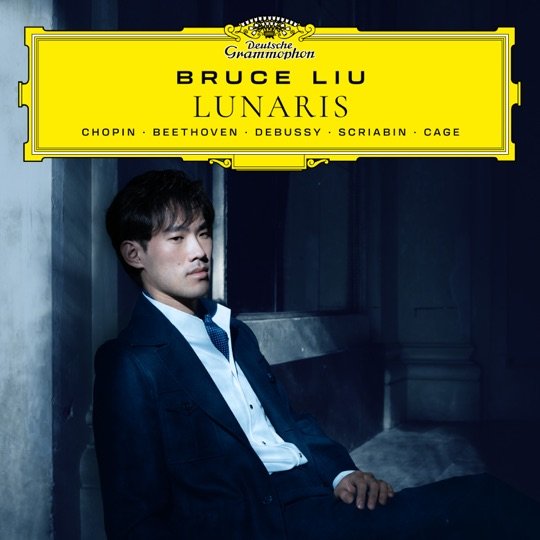

I came to this latest release, Bruce Liu’s fourth full album for Deutsche Grammophon, expecting a lot. And what we get is much more than I expected.
For all Liu’s rapid rise since winning the Chopin International Piano Competition in 2021, Lunaris gives us something we have not previously had from him on record: major Beethoven. In the lead-up to the August 7th release, Liu and DG have been pushing the concept of the album, a “nocturnal journey” of sorts, with an extraordinarily diverse lineup of composers including Mompou, Schoenberg, Reynaldo Hahn, Ligeti, and John Cage. But it’s the Beethoven that stands out. As far as I’m concerned, his readings of the “Waldstein” and “Moonlight” sonatas completely change my idea of what we can expect from Liu as he continues to develop his already remarkable career.
A comparison keeps surfacing as I listen: Liu makes me think of Yunchan Lim. Both have followed similar trajectories, as two of the most compelling young pianists to emerge from major piano competitions in the early 2020s (Lim won the 2022 Van Cliburn). They are both rising stars of a remarkable pianistic generation. And, both Liu and Lim have the gift for finding unexpected detail in familiar music, while convincing you this is exactly what the composer must have meant. But there’s a subtle difference in flavour. With Lim, my reaction is “where on earth did that come from?” With Liu, it’s “ahhh… why didn’t I hear it before?”
I’ve previously examined how Bruce Liu does this, for example I traced his methods in my Bruce Liu Daily Playlist entry earlier this month, in anticipation of this release. Up to now, it has all been about his spectacular control of pianistic colour, and his remarkable precision in finding and voicing multiple melodic strands inside complex textures. Both of these qualities are all over Lunaris, from the immaculate layered cantilena of the opening Nocturne, to the rhythmic mischief of Ligeti’s “Fanfares.”
But the Beethoven performances here reveal a new string to his bow, and it elevates his arsenal of interpretative tools to a new level. Throughout both sonatas, and especially in No. 21 (“Waldstein”) he exercises an exhilarating command of articulation and touch, running from creamy singing legato, through an extraordinary range of pearly détaché, and on to sparkling staccato, using those changes not as decoration but to prepare the returns of the opening idea and sharpen the long argument. Listen to how he prepares the returns of the opening theme in the Waldstein‘s first movement – each arrival announced differently, with articulation carrying weight, alongside colour, pedalling, and agogic gestures. And the Rondo finale could stand as a masterclass in precision articulation – if it weren’t such a compelling musical statement in every other respect as well.
This is a collection of skills and traits I associate with an older Russian tradition of piano virtuosity… and with one name in particular: the brilliant, under-appreciated Shura Cherkassky (1909–1995). What made Cherkassky extraordinary wasn’t simply colour. Like Liu, Cherkassky combined colour with an almost limitless gradation of touch, a singing legato layered against inner voices brought forward for a phrase and allowed to vanish again, and underneath it all, a remarkably secure rhythmic spine that let him stretch and linger without ever losing the meter. That art came down to him directly: Anton Rubinstein taught Josef Hofmann, and Hofmann taught Cherkassky (who was born in Odessa).
I hear all of that in this new work from Bruce Liu. Now, I’m about to go off the deep end, so bear with me! Could it be that Liu follows a similar lineage through his own training, tracing back to the Russian school? I think maybe so: one of his later teachers is Dang Thai Son; Dang trained at the Moscow Conservatory with Dmitri Bashkirov; Bashkirov was a pupil of Alexander Goldenweiser, one of the central pedagogues of the old Russian school; Goldenweiser studied with Alexander Siloti (and Liu plays a Siloti transcription of Bach on Lunaris); and Siloti was a pupil of Nikolai Rubinstein (Anton Rubinstein’s younger brother) before later studying with Liszt.
This matters (to me, at least) because this is a performance practice tradition that has mostly disappeared from mainstream pianism since Cherkassky’s generation. I’m genuinely excited at the prospect that Liu (whether he knows it or not!) is a possible 21st-century reclaimer of that particular line of articulation, voicing, and spontaneous re-creation. Lunaris is the first of his albums where I hear the potential fully formed.
Let’s get back down to earth. The nocturnal “moonlight” concept of the album works effectively enough in a straight play-through of the album, at least from track 1 through track 13, Chopin to Mompou by way of the Moonlight. The romantic flow is absorbing, and the sequencing is well thought-out (like the enharmonic connection between the D flat Chopin Nocturne and the C sharp minor Moonlight sonata). But after the Mompou pieces, I find that the mood breaks. From there, Schoenberg through Cage, the album continues as an engaging modern recital rather than a continuous dream. Your mileage may vary: read the extensive discussion of the programme concept in the album liner notes if you’re curious).
If you prefer, there’s a simple workaround: enjoy the romance and moonlight through the first thirteen tracks as the concept intends. Take a break. Then come back for the modernist set on its own terms.
A word on production, because it’s unusually central here. The album was recorded at Teldex Studio in Berlin over sessions in December 2025 and January 2026, with René Möller producing… and collaborating. Liu recorded on two instruments – a Yamaha and a double-keyboard Steinway – sometimes playing the same work on each, with Möller and his team combining takes in post-production. In the Cage, where the same material comes round three times, he Liu even uses a different keyboard for each pass. This is an intriguing extension of Liu’s focus on colour expression into the studio itself. The piano sound, whichever the keyboard of the moment, is DG top-tier excellent. For streaming, we have a Dolby Atmos mix, which sounds excellent, with the spatial atmosphere is well suited to the repertoire.
I should mention one format wrinkle that will matter to some: the vinyl and streaming/download editions of this album contain two tracks – Rynaldo Hahn’s haunting “Hivernale” and the Schoenberg – that apparently don’t fit on the CD edition. So if you want the full meal deal, don’t opt for the CD.
Favorite MomentBack to Top
I’m tempted to pick a micro-detail from either Beethoven sonata – there are dozens of possibilities to call “favorite.” But what I keep returning to is the intake of breath that follows the Moonlight sonata: Debussy’s Rêverie, melting into the Siloti transcription of Bach’s E minor Prelude. Two short pieces of transcendent beauty, the Debussy drifting at the threshold of sleep and the Bach reducing everything to a luminous essence. This feels like the album’s concept at its best.
Further ListeningBack to Top
Yunchan Lim, J.S. Bach: Goldberg Variations (Live at Carnegie Hall, 2025) (Decca, 2026). The other young pianist rethinking core repertoire to startling effect – but where Liu persuades you the surprises were always in the score, Lim makes you gasp at where they came from. Two temperaments – joined at the hip? – chasing the same kind of fresh insight.
Shura Cherkassky, 1982 San Francisco Recital (Ivory Classics, 1999). The tradition Liu may be reclaiming, caught live near the end of its unbroken line – capricious, colouristic, rhythmically elastic, and underneath it all rock-solid. Not a note sounds standardized. This is Cherkassky as I last heard him live, at the Royal Festival Hall in London, 1985.
Igor Levit, Beethoven: The Complete Piano Sonatas (Sony Classical, 2019). The most discussed Beethoven cycle of recent years, intellectually gripping and fiercely driven. Hearing his Waldstein against Liu’s makes the contrast of temperament vivid.