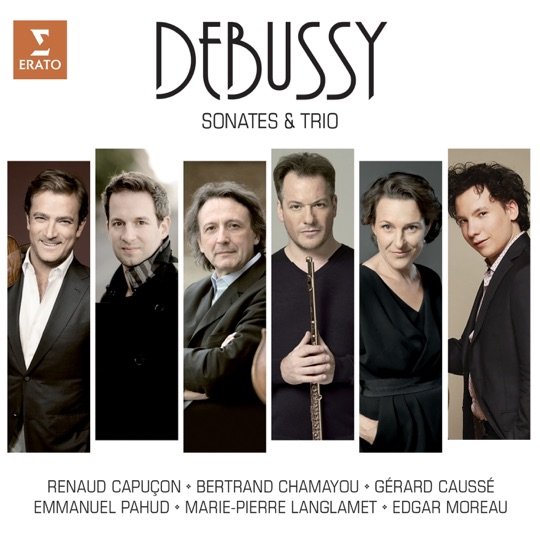

There is something fitting about a cast of French musicians making a concerted case for Debussy’s late chamber sonatas, and this Warner Classics release from 2018 — Debussy’s centenary year — assembles a group of exactly that kind: Bertrand Chamayou at the piano, Renaud Capuçon on violin, the young Edgar Moreau on cello, with Emmanuel Pahud, Gérard Caussé, and Marie-Pierre Langlamet in the trio. The result is an album that knows this music from the inside — from within a living performance tradition — and plays it with a freedom that comes from familiarity rather than licence.
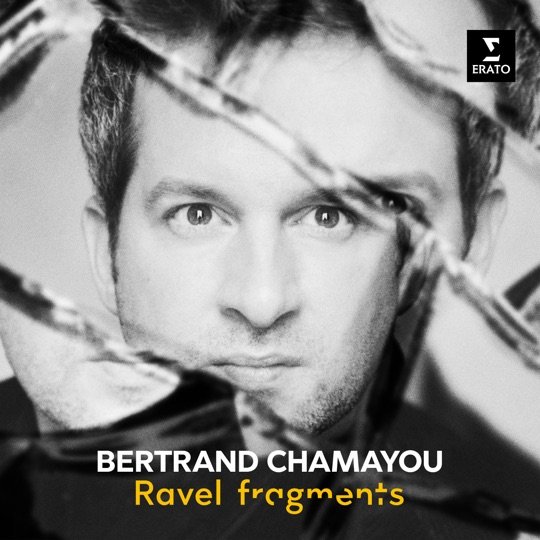
Chamayou is the organizing intelligence here. He’s a pianist with a deep feel for French impressionist idiom, and in both the Cello and Violin Sonatas he functions as an ideal listener as much as a partner: shadowing, commenting, occasionally pushing the tempo in ways that keep the harmony fluid. His touch in the Prologue of the Cello Sonata is dry and precise without being harsh, and this clarity pays dividends when the Sérénade‘s more grotesque gestures arrive — they sound properly strange rather than merely difficult.
Edgar Moreau’s cello playing in the sonata is the disc’s most arresting individual contribution. He was in his early twenties at the time of recording, and the sheer directness of his approach — no rhetorical overplaying, no sentiment forced onto resistant material — gives the work an unsettled vitality that suits Debussy’s late-period laconic wit. The pizzicato passages in the Sérénade are particularly fine: dry, fleet, and pointed.
Renaud Capuçon’s Violin Sonata is a more polished affair. His tone is larger and more consistently beautiful than some rivals’ — there are passages in the Allegro vivo that simply glow — and he and Chamayou find a real momentum in the finale. The risk is that the music occasionally sounds more sure of itself than Debussy probably intended; this is the one moment where the French insider knowledge tips into confidence that papers over cracks the music itself left deliberately open.
The Flute, Viola, and Harp Sonata is suavely played: Pahud has a singing, rounded tone that contrasts interestingly with the more veiled harp-writing from Langlamet, and Caussé in the viola part brings the right mixture of warmth and detachment. This is chamber music played at the highest level, even if it doesn’t unsettle quite as much as the best recordings of the work.
Favorite MomentBack to Top
I think about the cello entrance in that sonata’s finale, where Moreau captures Debussy’s intentions “Animé, léger et nerveux” just so: he skips lightly over a repeated figure, and Chamayou catches it mid-air with a dry, syncopated chord, and the two of them suddenly sound like a street musician and a passerby who’ve stumbled into a piece of secret music together.
Further ListeningBack to Top
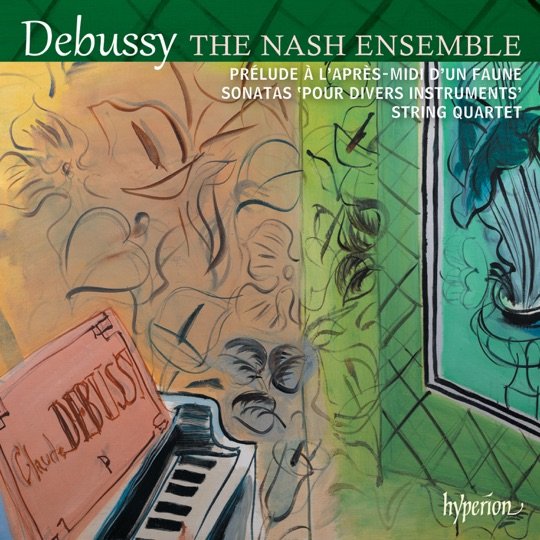
The Nash Ensemble’s 2025 Hyperion recording adds the String Quartet and a chamber arrangement of the Faune to the same core programme, making it the most comprehensive single-disc survey of Debussy’s chamber world; and the ensemble warmth of musicians who regularly play together is something an ad-hoc all-star lineup, however fine, can’t quite replicate.