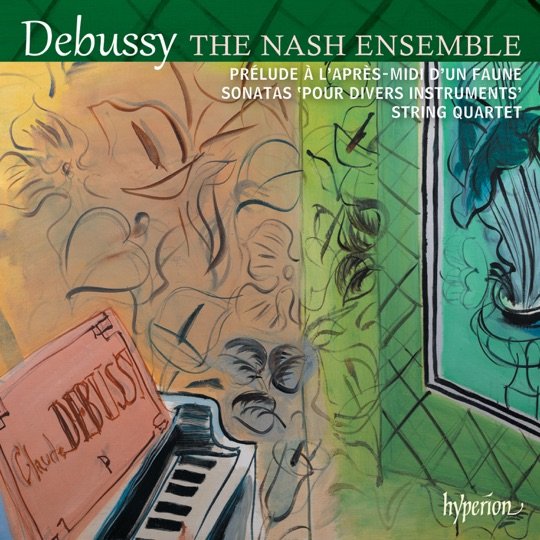

Debussy’s late sonatas are among the most treacherous works in the chamber repertoire, and some recordings of them sound as though the performers know it. The tell is overly-beautified tone, the slightly-too-careful ensemble precision, and a reluctance to dig into the strangeness. The Nash Ensemble, celebrating their sixtieth anniversary with this Hyperion release, have no such inhibitions.
Debussy composed these sonatas in the last years of his life: the Cello Sonata; the Sonata for Flute, Viola, and Harp; and the Violin Sonata. These are not impressionist mood-paintings, they are the work of a composer in physical decline, writing with furious concentration, stripping everything back to the essential. Too many recordings forget this. The Nash Ensemble is willing and able to meet Debussy where he’s coming from.
In the Cello Sonata, Adrian Brendel’s playing is muscular, unsentimental, and rhythmically alive. Gentler versions can sound like the cellist is tip-toeing around the score. The Nash’s Sonata for Flute, Viola, and Harp does away with the gauzy floating atmosphere that sometimes pervades a more standard performance. And Stephanie Gonley’s violin in the G minor Sonata is a controlled marvel. Her silvery tone is ravishing, but it never loses its edge or tips over into prettiness for its own sake. The finale, which Debussy described as “full of tumultuous joy,” really does sound tumultuous for a change.
The album actually opens with the familiar and beloved Prélude à l’après-midi d’un faune, in an arrangement for 12 players by the Nash’s David Walter. You could argue all day whether this repertoire needs a chamber arrangement. But it does earn its keep here, with an intimacy and textural clarity that a full orchestral performance can’t match. You lose some of the glow and spaciousness, but you gain a clearer presentation of beautiful melody and the ebb and flow of energy.
The String Quartet, again familiar territory for Debussy fans, the disc and earns its place: this is not a warm-up. The Nash shape the first movement’s cross-rhythms with a clarity that throws the music’s formal ingenuity into relief, and the scherzo’s pizzicato is precisely the kind of moment where lesser ensembles coast and great ones commit.
Andrew Keener’s production and Oscar Torres’s engineering at All Saints’ Church, East Finchley (one of Hyperion favorite settings) are as fine as you’d expect: present, unforced, and in service of the music.
Favorite MomentBack to Top
I often turn to the second movement of the Violin Sonata, marked “fantasque et léger“, to take the temperature of a performance. Its mood shifts from playfulness to introspection within single phrases, and most violinists iron out the seams. Gonley does better. There’s a moment about two-thirds through where the energy simply evaporates mid-phrase, dies to almost nothing, and then refuses to recover in the way you expect. On this recording it sounds like a door closing very quietly on something irreplaceable.
Further ListeningBack to Top
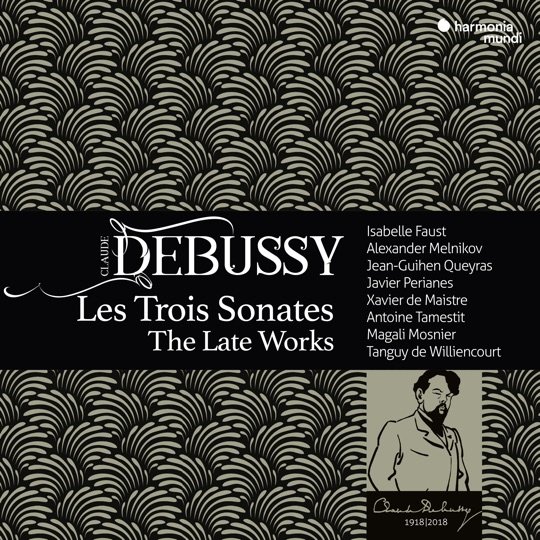
Debussy: Les Trois Sonates, The Late Works (Harmonia mundi, 2018) This set makes a strong comparison in the three sonatas. Isabelle Faust is hard to beat in the Violin Sonata, with Alexander Melnikov. And the other sonatas get solid performances with a different flavor to the Nash recordings.
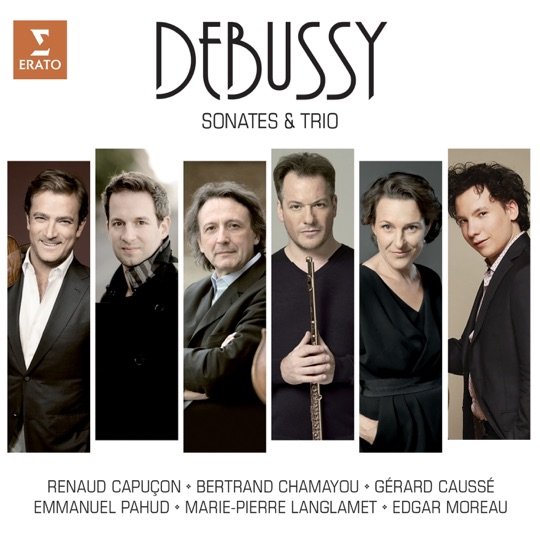
Debussy: Sonatas and Piano Trio (Erato, 2017) It makes sense to look to a French performance and production to get a take on these works that is steeped in the culture and tradition. And in Edgar Moreau, Bertrand Chamayou, Renaud Capuçon, and Emmanuel Pahud, you’ve got the leading lights of today’s chamber scene in France. It’s a great listen.