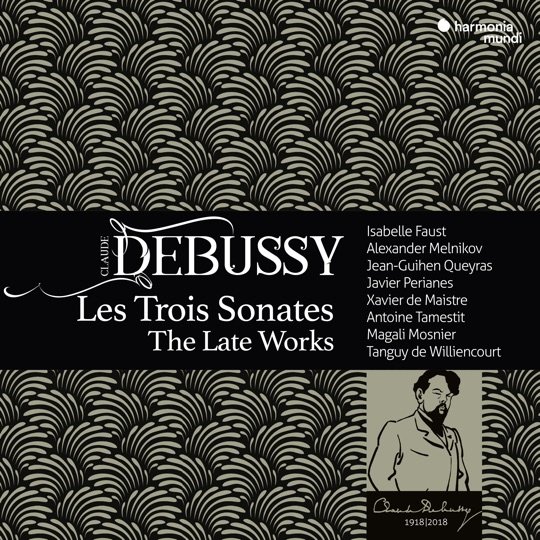

The year 2018 marked a century since Debussy’s death, and among the recordings it produced, this Harmonia Mundi album stands out as a document of genuinely probing musicianship. Six soloists of the first rank, each associated with thoughtful, historically aware chamber playing, take the three late sonatas at their own pace and on their own terms. Javier Perianes adds a little extra spice with solo piano miniatures that serve as palate cleansers and context-setters.
Debussy wrote his three sonatas — for cello and piano (1915), flute, viola, and harp (1916), and violin and piano (1917) — in the last years of his life, weakened by cancer and chilled by the First World War. The music carries that knowledge without a heavy hand. There is irony, lightness, and even wit here alongside the quiet desolation.
Many performances opt for lyrical beauty and smooth it into a single emotional tone. This recording doesn’t. Each sonata gets a distinct character, and the musicians understand that the contrasts within each work are the point.
Jean-Guihen Queyras and Perianes in the Cello Sonata are the most dramatically committed partnership here. The Sérénade‘s pizzicato passages are spectral, and the finale has an unstoppable momentum. Where some cellists make the Prologue stately, Queyras finds something more interesting and unsettling, as if the music is searching without finding. And in the Flute, Viola, and Harp Sonata, Emmanuel Pahud, Antoine Tamestit, and Xavier de Maistre project a smoothly locked-in ensemble quality that masks the music’s underlying slipperiness; their Pastorale opening is one of the most sustained pieces of collective chamber playing you’ll encounter in this repertoire.
Isabelle Faust’s Violin Sonata is something else again. Her intonation and phrase-shaping in the Allegro vivo are meticulous without being cold. You hear exactly what Debussy marked in the score without the feeling that notes are being ticked off a list. Her tone is lean rather than rich, and that feels exactly right for music that makes suggestions rather than statements. Perianes is an ideal partner: responsive, never self-congratulatory, always listening.
The recording itself is immaculate. Harmonia Mundi’s engineering captures an acoustic of warmth and clarity, and the balance between instruments in the trio sonata is handled with skill.
Favorite MomentBack to Top
The first three minutes of Queyras’s Sérénade in the Cello Sonata: the opening pizzicato line repeated twice, quietly, like a tap on the shoulder in a dark room. Perianes leaves just enough space before responding that you genuinely don’t know what comes next. The exchange between them in those bars has a wit and strangeness that makes you reconsider the whole work. This is the passage I come back to when I want to test whether a new recording of the piece has really taken the music seriously.
Further ListeningBack to Top
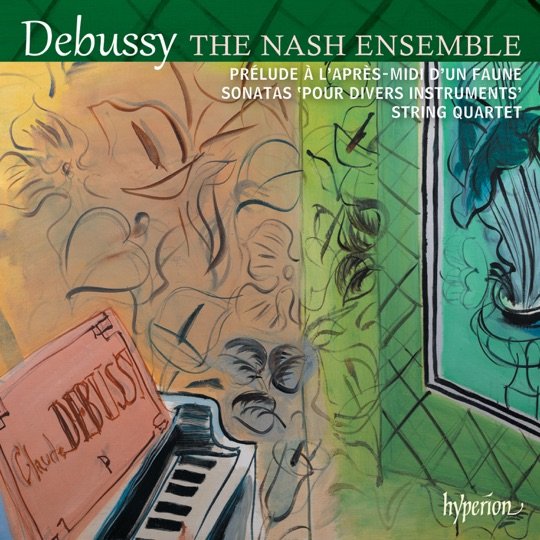
The Nash Ensemble: Debussy String Quartet & Sonatas (Hyperion, 2025) My top recommendation for this repertoire, covering much of the same ground. Also includes Debussy favorites: the String Quartet, and the Nash’s own arrangement of Prelude a l’apres-midi d’une faune, making this the more comprehensive portrait of Debussy’s chamber world.