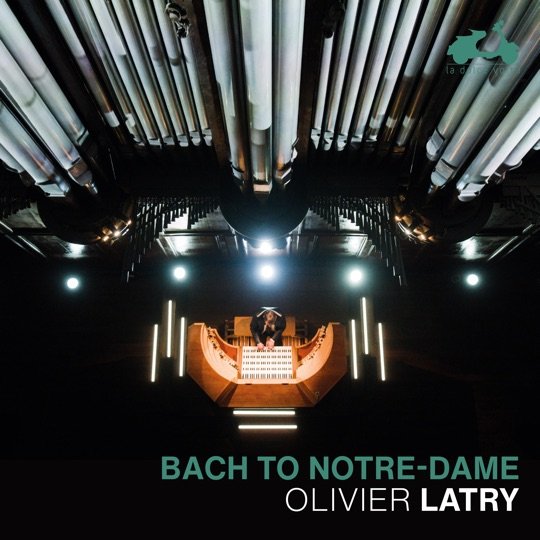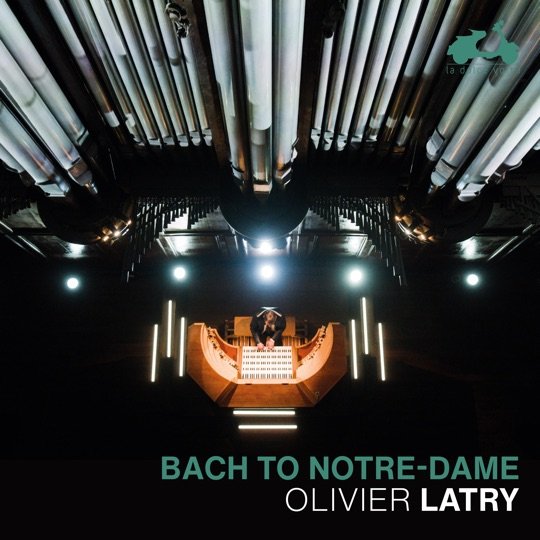

I was in Paris not long ago and went to see the resurrected Notre-Dame Cathedral as a regular tourist. I had actually booked tickets to an after-hours concert so I could hear the choir and organ in ideal circumstances, but it was cancelled on short notice. So what I got instead was a few minutes of somebody noodling through a practice session while my wife and I shuffled round the nave with the crowd. That was enough to leave me wondering what the almost legendary old Cavaillé-Coll really sounds like when someone gives it a proper workout. Or for that matter, what it may have sounded like before the fire of 2019. As it turns out, we don’t have to wonder, thanks to this new release of Bach to Notre-Dame … itself a post-conflagration restoration project.
The album has an unusual back story. First time around in 2019, it was released as Bach to the Future, which made sense (of a kind) at the time. The title was a play on the hit movie Back to the Future, which came out in the year of Bach’s tercentenary in 1985; and the original booklet showed a tricked-up futuristic image of Notre-Dame’s organ console looking like the flight deck of something coming in to land. Olivier Latry even played along with the cheesy futurist concept by salting his performances with some… let’s say “odd” registrations (listen to his “Ich ruf zu dir”).
Then came the fire, the five-year restoration, and the reopening of Notre-Dame in 2024. At which point, La Dolce Volta decided to make hay, so to speak, taking advantage of the media frenzy surrounding the event. The album returned as Bach to Notre-Dame, renamed with a new pun, remastered with a new spatial audio mix, and marketed to tourists as a souvenir. The performances are the same, of course, just as enjoyable (and quirky) as they were in 2019.
The all-Bach program is a generous serving of mostly familiar favourites: the Ricercar a 6 from Musical Offering, the “Little” Fugue in G minor, the obligatory Toccata and Fugue in D minor (Latry’s first ever recording of it, though), three chorale preludes, the Pièce d’orgue, and the Passacaglia in C minor. None of this repertoire is a natural fit for a French symphonic organ, although the opulent reverberance of the Cathedral irons out some of the wrinkles. But Latry makes no apologies, and gets on with the job of making it work… and quite beautifully so.
He reconciles the stylistic contradictions by appreciating what his instrument does best, then finding ways for Bach to meet it halfway. His extensive program notes in the accompanying booklet are quite illuminating, describing what he terms his sincerity in developing a modern approach that is true to the music’s essence.
Opening with The Musical Offering selection, Latry separates the contrapuntal voices across manuals, as Bach could never have done with an organ of his own time, and lets each entry arrive with its own colour and physical position. He maintains clarity of line by allowing the rich resonance of the space to complete each phrase, without waiting so long that the musical pulse goes slack.
The Fantasia and Fugue in G minor, BWV 542, shows the same instinct on a larger scale. Latry tells us that he approaches the Fantasia through the dramatic engineering of Liszt’s familiar piano transcription, giving its harmonic tangles a dark, orchestral weight. Once again, the Fugue’s entries stalk in from different divisions, and accumulate to throw off sparks without losing the architecture.
His registrations are not wild for shock value. In the chorale prelude In dir ist Freude, you may be startled to hear the organ’s chimes turning Bach’s insistant pedal figure into peals rolling through the building. But it’s a well-judged novelty, since the bell tones grows directly from the musical imagery of the chorale.
Latry’s Toccata and Fugue in D minor also sits well outside of conventional expectations, in dynamics, tempo variations, registration contrasts. The example of Stokowski’s orchestral re-imaginings sits somewhere behind the blaze of reeds and shifting sonorities, and Virgil Fox of “Heavy Organ” fame would be proud. But Latry’s essential musicality and understanding of Bach holds the ship steady, through to a blazing finale that tells you a great deal about the storied qualities of this instrument.
The packaging of the album implies an intention to wow listeners with a sonic spectacular. Let’s give it a middling mark, it that’s the test. The engineering captures the organ from a believable middle distance, close enough in perspective to capture a brilliant range of tonal character, immense dynamic range, and a bottom end that underpins without swamping the rest. Qobuz offers the 24-bit/96 kHz stereo master, which allows the brilliant highs to shine without unattractive sizzle. The Atmos spatial presentation on Apple Music opens a pleasingly vast space around the listener that extends upward and behind without becoming unnaturally emphatic. Spatial is the way to go if you have a choice.
Favorite Moment
The big pieces make their impact without any special pleading from me, so I’ll point you instead to two of the chorale preludes. For “Erbarm’ dich mein, o Herre Gott” Latry adopts a measured and solemn pace, with a subdued accompaniment and an incisive solo stop tracing the chorale tune. This makes a mysteriously affecting pairing, subtle artistry of a high order. And then “In dir ist Freude,” a celebratory marvel that I have played myself any number of times as a joyful wedding recessional. I would love to have played it — just once — exactly like this, with chiming bells on the pedals! Enjoy.
Further Listening
Pierre Cochereau, L’organiste de Notre-Dame (Solstice, 1975). Cochereau held this post from 1955 to 1984 and personally drove the 1960s rebuild that gave the instrument electric action and a neoclassical brightening. Same organ, earlier state, played by the man who reshaped it – and a hotter, more theatrical temperament than Latry.
Simon Preston, Royal Albert Hall Organ Restored (Signum, 2006). Another famed instrument, and another tale of restoration. Here, the Henry “Father” Willis organ, familiarly known as “the Voice of Jupiter”, is caught shortly after its own resurrection, a transcription recital. It makes an interesting comparison: the Willis organ is a blunter, drier, more English machine… without the 7-second reverberation of Notre-Dame to hide behind.