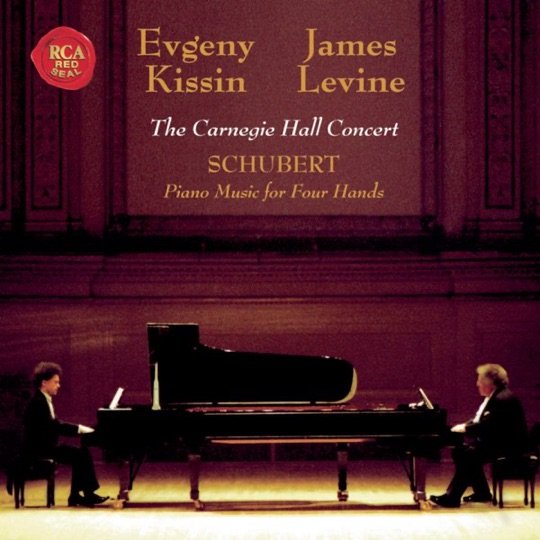

The obvious distinction of this concert recording is Evgeny Kissin’s and James Levine’s decision to play Schubert’s four-hand works on two separate pianos, rather than at a single keyboard. Why would they do that?
Schubert wrote this music for the drawing room, for two friends at one bench, enjoying music in close camaraderie. This entails a specific kind of closeness, with voices overlapping, hands crossing, and the shared pedal forcing a constant negotiation of sonority. Kissin and Levine, seated at two Steinways on the Carnegie Hall stage in May 2005, sacrificed that connection, but gained something else: fullness of texture, and a sheer physical scale that tilts the music toward the orchestral.
The Grand Duo, D. 812 is Schubert’s longest and most symphonically-conceived four-hand work, and this is where the two-piano strategy really pays off. Levine, of course, is a masterful conductor more than a pianist, and he brings the conductor’s command of architectural shape to the long-range phrasing, most notably in the Andante. The opening movement is conducted like a chamber symphony, with the two-piano medium allowing the expansive melodic arches to breathe without getting congested. And throughout, Kissin reins in the tendency to mannerism that sometimes mars his solo recordings, playing with focus and restraint. Following the conductor, so to speak.
The Fantasia in F minor is more complicated. This is music of profound interiority, and the two-piano setting inevitably pushes it outward. The Largo is powerful, but declamatory where it might have whispered. The fugal finale builds to a formidable climax. If you come to this recording after the intimacy of Murray Perahia and Radu Lupu (see below), Kissin and Levine may feel overblown. Heard on its own terms, as a large-scale concert event that takes Schubert’s late-period intensity seriously, it is harder to dismiss.
The Lebensstürme is works particularly well here. Levine and Kissin play with urgency and a quality of barely contained momentum, giving us one of the most gripping readings of this under-rated work in the catalogue. RCA’s live-pickup audio copes with the unusual arrangement of two pianos nicely, keeping spatial separation clear without making the stereo picture feel artificial.
Favorite MomentBack to Top
Have a listen to the Grand Duo’s finale, and the closing bars in particular. I’ve never heard it played quite like this anywhere else. This denouement is sometimes comes off as hollow or thin, as if Schubert’s pen ran out of ink. Here, with two pianos sharing the load, those final pages bring some real weight and a satisfying conclusion. Maybe Schubert’s piano writing at its most ambitious needs more piano than one instrument can provide.
Further ListeningBack to Top
Daniel Barenboim & Radu Lupu — Schubert Grand Duo etc. (Warner Apex, 2010). This is a fine alternative, intimate and songish. Lupu’s tone makes every phrase breathe differently, and Barenboim provides just enough structural backbone without… over-conducting. For those who want the Grand Duo as domestic music rather than public spectacle, this remains a touchstone.
Bertrand Chamayou & Leif Ove Andsnes — Schubert: Four Hands (Erato, 2025). Includes the Fantasia in D Minor D. 940 and other duet works. Here is the opposite end of the spectrum from Kissin and Levine: one piano, one bench, and focused concentration on the inner life of these late works. Fine spatial audio, on the “big” side, where available.