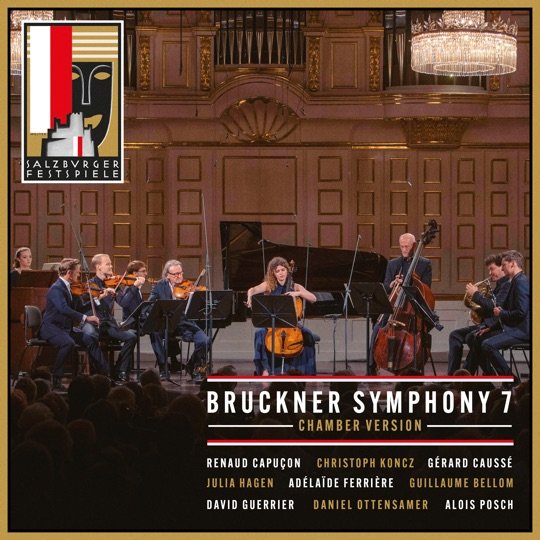
One of the most interesting new releases hitting the streaming music services today is a chamber ensemble version of Bruckner’s Symphony No. 7 in E Major, led by star violinist Renaud Capuçon in a performance recorded at the 2021 Salzburg Festival.
Symphony No. 7 in E Major (arr. E. Stein, H. Eisler and K. Rankl for Chamber Ensemble): 3rd Movement (Platoon, 2026)

One of the themes of Salzburg 2021 was “larger chamber works and unusual arrangements”, and Capuçon stepped up to the plate with this most unusual specimen. He assembled a crack 9-piece group for the occasion, including violinist Christoph Koncz, cellist Julia Hagen, and clarinet Daniel Ottensamer. It’s a string quartet, plus bass, clarinet and horn, with piano and harmonium filling out the texture, quasi-orchestral. You will be asking yourself, how well can you possibly present the huge weight of a Bruckner symphony with nine players? My answer is: pretty darned well!
I have to admit I’m not a huge fan of Bruckner and Mahler, their excesses and bloat and fleeting moments of radiant beauty. So my reaction to this scaled-down marvel is possibly not typical. But I find it quite refreshing to hear Bruckner’s bombast pared down to its essential core: the reduction makes the symphony newly discoverable, almost as if hearing it for the first time.
The other question that comes to mind is: why did Erwin Stein and his associates make this arrangement? It’s actually an intriguing piece of music history. Stein was a leading figure in the musical circle that gathered around Arnold Schoenberg in Vienna beginning in 1918. They had a catchy name Verein für musikalische Privataufführungen (Society for Private Musical Performances), and they put on remarkably intensive, organized series of concerts that became the alternative to Vienna’s normal concert life.
The Verein was dedicated to understanding and promoting modern music, but “modern” encompassed a range “from Mahler and Strauss to the very youngest.” Programs included Debussy, Ravel, Stravinsky, Bartók, Scriabin, Satie, and Korngold, among many others. Schoenberg actually withheld his own music from the proceedings for the first year or so, presumably to establish that this was not just a vehicle for self-promotion. To present large orchestral works, the Verein (and Schoenberg’s composition students) frequently made their own chamber ensemble arrangements, such as the Bruckner Seventh Symphony.
The odd twist to the story of this Bruckner arrangement is that it was never performed by Schoenberg’s circle. It was prepared for a concert near the end of 1921, but the Verein initiative collapsed before it could be performed. According to the score’s publisher, Breitkopf & Härtel, it remained unperformed until 1994! And now we are able to enjoy a fine top-drawer performance in modern spatial audio, thanks to Capuçon & Friends.
Here’s another example of the Verein’s remarkable work, this time with the able hand of Schoenberg himself as one of the arrangers (his work on this was actually completed in 1980 by Rainer Riehn): Mahler’s Das Lied von der Erde, in a recent performance by the Texas ensemble WindSync, with the Balourdet Quartet and others also participating.
I’m surprised to learn that Debussy loomed large in Schoenberg’s programming. The Verein concerts presented no less than sixteen Debussy works – more than any other composer except Reger – and there were concerts devoted entirely to his music. Schoenberg regarded Debussy not as an opposing “French Impressionist,” but as one of the central creators of modern musical language, demanding the kind of repeated listening the Verein project was designed to encourage.
The challenge for the arranger with Debussy was to translate orchestral colour rather than scale and weight. A case in point is the lovely Prelude à l’après-midi d’un faune, which was re-worked in 1921 by Benno Sachs. This is a particularly skillful reduction, because the orchestral colour of the original is inseparable from the music, with flutes, oboes, cor anglais, clarinets, bassoons, horns, two harps and more in play. Sachs reduced Debussy’s orchestra to just eleven players. Soft washes of orchestral colour become individual lines and carefully judged harmonic layers.
Needless to say, Schoenberg and his acolytes were not the last revisionists who went all in for arranging big romantic orchestral scores for tiny ensembles. Let me finish off this playlist with a rather extreme example, dating from the 1950’s. How about a Richard Strauss tone poem, reimagined in 1954 for just 5 players: violin, clarinet, horn, bassoon and double bass? It’s more like a Coles Notes condensation, but still great fun in live presentation because you get to see five over-worked musicians impersonating the entire Straussian orchestra.
Franz Hasenöhrl’s 1954 Till Eulenspiegel—einmal anders! (Till Strikes Again?) was not a Verein project, but a later work conceived in a puckish reflection of the original concept. It is subtitled Grotesque musicale, and it turns Strauss’s huge tone poem into an eight-minute romp, the reduction itself becoming one of Eulenspiegel’s audacious pranks.