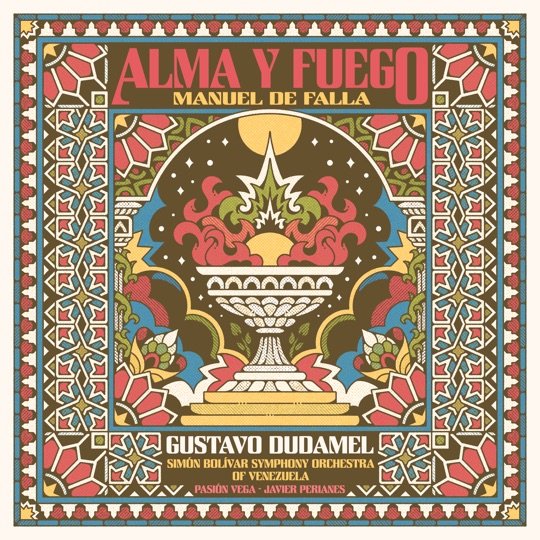

This digital-only programme of Manuel de Falla favorites from Gustavo Dudamel and his Venezuelan orchestra lands at an unnervingly charged moment. We have a confluence of reasons to pay special attention: the 150th anniversary of the composer’s birth; the golden jubilee season of El Sistema, Venezuela’s music education programme that incubated both Dudamel and the Simón Bolívar orchestra (founded 1975); Dudamel himself shaking up the musical world with his move from the Los Angeles Philharmonic to New York. And of course, this music arrives as Venezuela is reeling from the impacts of coercive regime change and the catastrophic June earthquakes that levelled buildings across Caracas and La Guaira.
So, I absolutely encourage you to spend some time with this album of Falla’s most popular orchestral works. Perhaps consider a donation to earthquake relief while you listen (suggestions and links below). But I have to tell you: this is a deeply flawed album. The performances are really fine, potentially top recommendations. But they are almost fatally undermined by exceptionally poor audio production.
Let’s talk about the good news first, the music and performances. The programme gathers three of Falla’s best-known scores: El amor brujo (Love, the Magician), in its final version; Nights in the Gardens of Spain (Noches en los jardines de España), with piano soloist Javier Perianes; and the second suite from The Three-Cornered Hat (El sombrero de tres picos).
The playing has all the rhythmic propulsion and sensuous colour you would hope for from this partnership of Dudamel and his Venezuelan orchestra. In the big opening work El amor brujo, Dudamel leads a rousing performance that resonates with the “Soul and Fire” (Alma y Fuego) promised by the album title. In the concerto-like Nights in the Gardens of Spain, Javier Perianes is a poised and colorful piano soloist, beguilingly integrated into the orchestral fabric as the composer intended (as he was not, in his earlier BBC recording with Josep Pons).
Now the bad news. The audio presentation, obviously intended as a sonic spectacular in generous Dolby Atmos surround, is frankly a disaster. “Overly reverberant” would be an understatement. This is a case of the recording team using a heavy hand with artificial reverberation to simulate the sonics of a large concert hall… and messing up badly. Since they have close-mic’ed everything before swamping it all in this messy manipulation, you can still hear a well-balanced, vivid representation of the orchestra in full color, but it sounds very strange. You get something like the acoustic of a cavernous and empty concert hall, but it’s not in the least natural or realistic. As well, the size and depth of the apparent soundstage shifts constantly, more or less tracking with the dynamics and intensity of the orchestration.
This flaw is most irritating in the song movements of El amor brujo, where the singer sounds like she is somewhere way off stage in a tiled bathroom, singing in the shower. And that’s a pity, because our singer here is Pasión Vega, an authentic flamenco vocalist who sings with great passion, and captures the authentic spirit of cante jondo, characteristic of Andalusian flamenco. This really does ruin the effect of her performance, I’m afraid.
I don’t want to flog a dying horse, but the woodwinds at all times seem to be too far back in a very deep soundstage. On the other hand, loud, brassy full-orchestra passages sound impressive – because the close mic technique captures a blazing brilliance that overpowers the sloshing reverb – but anything quieter or in any way subtle sounds odd and distinctly distant. The bottom line is that the sound quality is terribly distracting. It doesn’t outright ruin the fine qualities of an overall engaging and colorful performance, but it tries.
For what it’s worth, you may get better results by switching to 2-channel stereo, either by turning off spatial audio in your system, or listening via a streaming service that doesn’t do spatial (such as Qobuz or Presto Music). The problem is clearly related to misguided handling of the surround/spatial audio mix. But even in stereo, the shifts of apparent stage depth at different volume levels is a distraction.
So where does that leave us? With an album you’ll wish you could go back to for repeat listenings… but you probably won’t. Listen for the way Dudamel shapes the quieter dances. The “Danza de los vecinos” that opens the Three-Cornered Hat suite has a sweet, unforced lyricism that is far more memorable than the pyrotechnics of the “Danza final”. Listen for pianist Perianes whirling through the “Danza lejana”, reminding us it really is a dance. And listen in stereo if you can’t stand the lousy Atmos mix.
Favorite MomentBack to Top
“El círculo mágico” from El amor brujo is a good test of what a conductor is up to in this music. It’s a fisherman’s ballad, music of superstition and moonlight, atmosphere and wistfulness. There are recordings that rush past it on the way to the pops concert warhorse of Ritual Fire Dance. Dudamel treats it with a dreamy hush, like a held breath, strings barely stirring, magical enough to make me forget about the unfortunate audio production… at least for a moment.
Further ListeningBack to Top
Pablo Heras-Casado, Mahler Chamber Orchestra, Marina Heredia: Falla, El sombrero de tres picos & El amor brujo (Harmonia Mundi, 2019). A modern benchmark for both ballets, and the obvious head-to-head collection. In both performance and recorded sound this is everything the Platoon production is not: a performance of clinical precision in place of Dudamel’s passion and excitement, and sonics that are clean, natural, and present.
Martha Argerich, Daniel Barenboim, Orchestre de Paris: Falla, Noches en los jardines de España (Erato, 1987, recorded live 1986). Still unparalleled in this work. Argerich plays it as an orchestral piece with piano rather than a concerto in disguise, sober and glinting by turns. Perianes is lovely, but this is the summit.