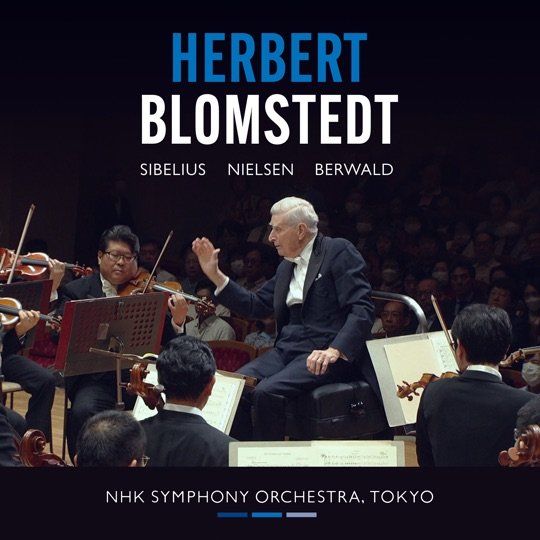

There is poignancy in the timing of this digital album. As of it’s release date in June 2026, Herbert Blomstedt has been forced to step back from conducting, following a serious bout of infection in May. At age 99, that’s not something to take lightly, and he has cancelled concerts around the world until at least October to recover. So this Tokyo performance arrives to remind us what a great Nielsen conductor and Scandinavian repertoire specialist Blomstedt has been. And indeed, still is!
There is a particular pleasure in hearing a conductor return, near the very end of a long career, to the music that made his name. Blomstedt was 97 when this concert was taped live at Tokyo’s Suntory Hall in 2024, and the program of Sibelius, Nielsen and Berwald is an apt representation of repertoire he has loved and championed. This is the Scandinavian repertoire that carried him through the orchestras of Stockholm, Oslo, Copenhagen and Swedish Radio in the 1960s and 1970s.
I have watched recent video streams of Blomstedt conducting the Berlin Philharmonic, as recently as April of this year, and what struck me is his ability to impress his musical vision and intentions with the orchestra, in spite of obviously limited physical mobility. Without visuals providing queues, what I hear first in this performance with the NHK Symphony is the alertness of the interpretation. The playing is sharp, rhythmically taut, and fully committed, without a trace of an autumnal haze that I might have been expecting.
Blomstedt and the NHK players are familiar partners, as he has been Conductor Laureate of the orchestra since 2016. And perhaps that is part of the reason why they mesh so well in this performance. Blomstedt has lost none of his ability to shape a long musical line, or to bring out an unexpected detail in the orchestral texture, and the orchestra plays along with passion.
The centerpiece of the program is the Nielsen Clarinet Concerto. This must be one of the strangest and finest wind concertos of the twentieth century: the soloist and an insistent snare drum stalk each other through rapidly changing mood swings across a single kaleidoscopic movement. It surely deserves to be programmed and played more often.
Kei Ito, the orchestra’s principal clarinet, is the excellent soloist. He tackles the long unaccompanied first cadenza early on with passion, and finds rollicking good humor in the finale. Blomstedt, Ito, the snare drummer, and the NHK woodwinds as a group are locked in: together they catch the work’s quicksilver temperament without smoothing off its rough edges. The strings handle their understated role with warmth and shape, playing well for Blomstedt.
The rest of the program fits well around the concerto. The Swan of Tuonela (a movement from Sibelius’s Lemminkäinen Suite) opens the concert in a poignant hush, with its swooning English horn melody floating out over the strings. This is practically a concerto in its own right, giving us a clue that the woodwinds are a focus of the whole program.
Franz Berwald’s Fourth Symphony, the “Sinfonie Naive“, closes things out. It is a likeable, open-air piece, with a slow movement that brings Schubert to mind, and Blomstedt clearly enjoys its good humor. I would not call it essential listening on its own, but in this thematic context it fits right in, and gives the strings a proper workout after the wind-dominated first half.
The recorded sound is very fine, as you would expect from NHK as a top-notch national broadcaster. The winds and percussion sit a touch forward of where they sound naturally in the hall, and it feels a bit off, but the added definition does highlight their crucial roles in the concerto. The Dolby Atmos spatial mix is top notch, making this an enjoyable “concert listening” experience, with the sense of sitting in a good seat at Suntory Hall, whether you listen on speakers or headphones.
Favorite MomentBack to Top
The restless, searching opening of the Clarinet concerto is a treat. Listen to how clarinetist Ito drives into his first big cadenza (around the 4:30 mark), and how Blomstedt keeps the orchestral interjections taut and dangerous. Knowing this was shaped by a 97-year-old, working with limited physical mobility, the sustained nervous energy of it is something to marvel at.
Further ListeningBack to Top
Nielsen: Clarinet Concerto (with Helios & Symphony No. 5) – Edward Gardner, Bergen Philharmonic Orchestra, Alessandro Carbonare (clarinet). (Chandos, 2025). Another well-engineered modern recording, but worlds apart from Blomstedt and Ito. This is smoother take on the concerto, cautious and almost halting. It works, after its own fashion.
Bernstein Conducts Nielsen – Leonard Bernstein, New York Philharmonic, Stanley Drucker (clarinet) (CBS/Sony, rec. 1967). The classic high-tension account. Drucker and Bernstein lean hard into the work’s anger and eeriness. The result is Alfred Hitchcock all over. Bernstein is always interesting, isn’t he?